


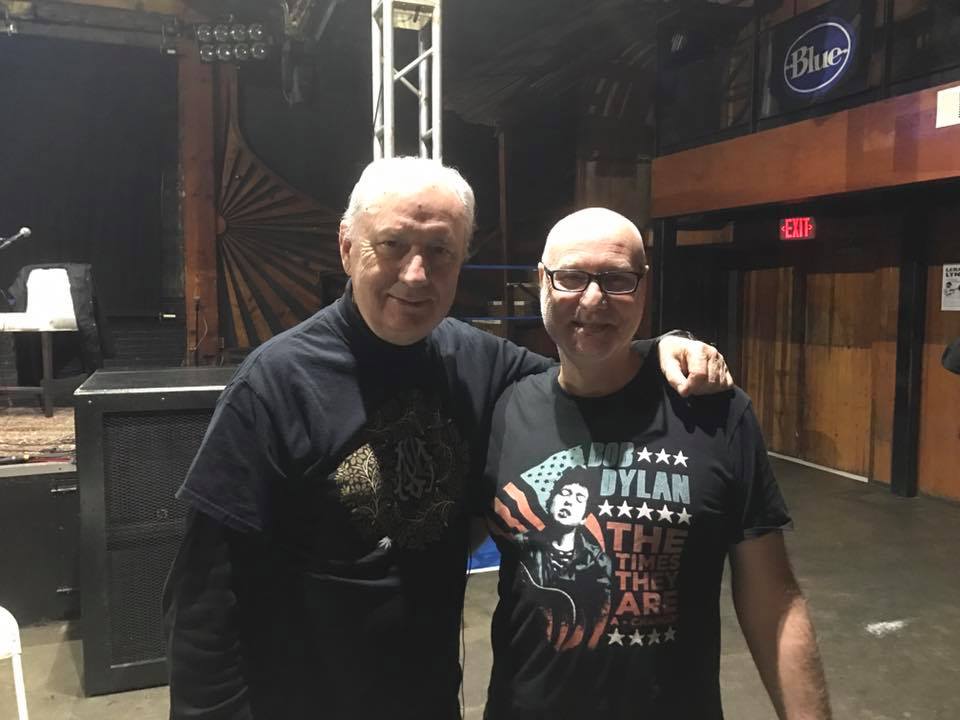
In January 2019 I had the honour of interviewing Monkees member, singer, songwriter, film maker and producer Michael Nesmith at the famous Troubadour club in Hollywood, California. I had traveled from Melbourne Australia that morning and went straight to the Troubadour, jetlagged to the hilt. It was just me, a camera and an audio recording device, with no lighting equipment at all. This is in Hollywood, the land of epic film production. I was so disoriented that I didn’t turn on the audio channel to my microphone. Thankfully Nesmith’s mic line was on. The original video that I posted back in 2019 also featured the dulcet tones of the Troubadour’s air conditioning system. Six years down the track, noise reduction software has improved dramatically and I’m now able to bring you this better quality version of the interview with no cuts.
Michael Nesmith: Stories from a Cosmic Cowboy
Interview by Greg Phillips – The Troubadour, Hollywood, 2019
In early 2019, Australian Musician sat down with Monkees legend, songwriter, filmmaker, and visionary Michael Nesmith for a rare and intimate chat at the historic Troubadour club in Hollywood. Fresh off a flight from Melbourne, editor Greg Phillips found himself face-to-face with one of pop culture’s most quietly revolutionary figures, a man whose creative reach stretched from the golden age of television to the dawn of MTV.
Reflecting on his early years, Nesmith traced his musical spark back to church hymns in Texas and the day he first saw Bo Diddley perform in 1958. “He reset my clock,” Nesmith said. “It was like a sound from a distant star.” That early fascination with rhythm and storytelling eventually informed his songwriting style: songs as short stories, rich in narrative and emotional honesty.
When asked how he learned to write songs, Nesmith mused, “I’m not sure I ever did. Songs came to me as ideas about people and moments.” Tracks like The Upside of Goodbye and Different Drum reflected his belief that a song should capture a single incident – not an epic, just a feeling.
He spoke candidly about the Monkees’ origins, likening their TV casting process to modern talent shows. Though he initially struggled to fit his “too country” songs into the band’s pop template, he viewed the experience with warmth and humour. “For a 20-year-old kid, I’d fallen into a tub of butter,” he smiled.
Nesmith recalled his recording sessions with the Wrecking Crew, his ambitious Wichita Train Whistle orchestral project, and the chaotic filming of the 1968 cult film Head-a “weed-filled weekend in Ojai” with Jack Nicholson, Dennis Hopper, and the Monkees’ production team. “We were laughing harder than anyone,” he said. “It was pure pandemonium, but joyful.”
His stories wandered through music history: being at the Beatles’ A Day in the Life session (“the right party, at the right time”), asking Jimi Hendrix to show him the lick from Purple Haze (“like asking the master to play Ode to Joy”), and forming the First National Band, one of the earliest bridges between rock and country.
Discussing his trailblazing video project Elephant Parts, which won the first ever Grammy for video and prefigured MTV, Nesmith called it “a gift from the skies.” He never saw himself as a filmmaker, but instinctively knew visual storytelling was the next frontier for music.
Nesmith also fondly remembered his Gretsch Country Gentleman guitars and an infamous night when his instrument failed mid-show, prompting Roger McGuinn of The Byrds to loan him a Rickenbacker 12-string. “It was strung backwards,” he laughed. “The show was terrible but the guitar was wonderful.”
As the conversation turned to his Australian connection, Nesmith lit up. He spoke of touring the country with Mickey Dolenz, his affection for local audiences, and his mother’s business ties through the Liquid Paper empire, which extended into Australasia. “Australia’s got the friendliest, happiest people I’ve ever met,” he said. “And one day, I still hope to make it to Tasmania.”
In the end, what lingered most was Nesmith’s humility and cosmic curiosity. Whether talking about songwriting, film, or philosophy, he radiated quiet wonder, the same spirit that made his music timeless. “Just shut up and listen,” he offered as his final wisdom. “Things come in and inspire.”
Michael Nesmith passed away on December 10, 2021