


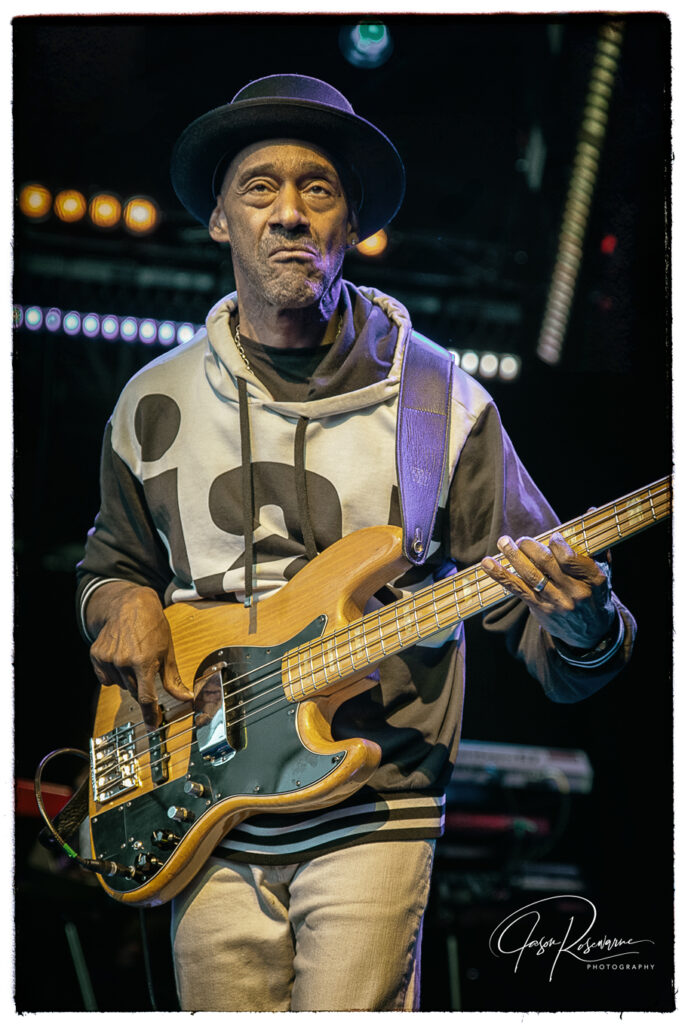
Marcus Miller is preparing to return to Australia in April 2027 for a five-date national tour, bringing with him a career that has encompassed jazz, funk, soul, R&B, composition, production and film scoring. The five-time Grammy Award winner last appeared in Australia in 2024 as part of the Melbourne International Jazz Festival, where he performed with his band and later joined Herbie Hancock at the Sidney Myer Music Bowl in front of over 10,000 people.
In conversation with Australian Musician editor Greg Phillips, Marcus Miller says he expects to return with essentially the same band but a substantially different program. Because he has not toured Australia extensively, he sees the 2027 shows as an opportunity to revisit older material that Australian audiences may not have heard live, alongside newer music. Although he prepares a set list, he deliberately leaves room for the unexpected. For Miller, live performance is about “energy, direction, manipulation”, and if he senses the band needs to move somewhere else musically, he is prepared to change direction on the spot.
MORE ABOUT THE INTERVIEW
The interview comes at an especially significant point in Miller’s career. He recently reunited with members of the original Miles Davis comeback band for a European tour, some 45 years after they last played together. Miller recalls being just 21 when he was in the band, and describes reconnecting with the musicians as being like a high-school reunion. Despite the decades and vastly different career paths separating them, he says their shared musical roots quickly became apparent once they began playing again.
That connection with Miles Davis remains a major thread through Miller’s musical history. He also recently performed at the Hollywood Bowl as part of a major celebration of Davis’s legacy, alongside musicians including Herbie Hancock, Ron Carter, Kenny Garrett, Christian McBride and Terrence Blanchard. The concert explored different periods of Davis’s career, from the Birth of the Cool era through his 1960s work and into the electric period of the 1970s and 1980s. Miller performed music from In a Silent Way and Bitches Brew, as well as material he wrote for Davis in the 1980s.
Miller offers a particularly revealing insight into his work with Davis when recalling the creation of “Tutu”. He would prepare complete demos for Davis, then sit beside him in the studio with a soprano saxophone, guiding him through the written parts while deliberately leaving space for spontaneity. Davis’s first take was often the one they ultimately used because, Miller says, it contained the most inspiration and interest.
More than four decades into his professional career, Miller says his own playing has become increasingly focused on rhythm and, specifically, the precise placement of notes within the beat. Rather than simply concentrating on technical complexity, he is fascinated by the subtle differences between playing ahead of, directly on, or behind the beat. He cites players such as Ron Carter and Paul Chambers as examples of how these tiny rhythmic decisions can profoundly affect the feel of music.
That attention to the bigger musical picture also helps explain why Miller has never regarded himself solely as a bass player. He began composing and arranging as a teenager, encouraged by a mentor who told him that a complete musician should also understand composition and arranging. Miller recalls making primitive multitrack recordings with two cassette players, gradually overdubbing drums, bass and other instruments despite the increasingly noisy results. He has consequently always viewed himself simply as a musician rather than limiting himself to a single role.
His experience playing alongside Stanley Clarke and Victor Wooten in SMV further demonstrates that philosophy. Miller says three bass players can easily become cluttered, but the trio worked because each musician instinctively occupied a different register. Clarke tended towards the upper range, Wooten the middle and Miller “the basement”, creating a surprisingly open and dynamic arrangement. What began as a one-off performance eventually developed into two tours after audiences responded to the music as more than simply a showcase for virtuoso bass playing.
Miller’s collaborative instincts extend into his work as a producer and film composer. He describes scoring films as a way of expanding his musical palette because the music has to serve a director’s vision rather than his own. The experience feeds back into his own recordings, influencing everything from instrumentation to chord progressions. As a producer, he similarly begins by talking to an artist about what they want to achieve, whether that means helping them realise a clearly defined sound or finding a new direction when they are unsure where to go.
Gear remains an important part of Miller’s musical world. For the Australian tour he expects to bring three basses: the Fender he has played since he was around 15 or 16 and which features on many of his recordings, a Sire fretless, and another Sire designed for a more modern sound. He describes the combination as “old school, new school, and a fretless”. He also stresses the importance of long-term relationships with instrument and amplification companies such as Sire and Markbass, arguing that collaboration with manufacturers can help musicians refine their sound.
Looking ahead, 2027 promises to be busy beyond the Australian tour. Miller has begun work on a new album after a lengthy period without releasing one and says he has accumulated a substantial amount of music. Rather than necessarily putting it all out as a single project, he is considering staggering the material across several releases during 2027. He is also involved with new Markbass amplification, while experimenting with Darkglass pedals and following developments in bass clarinet technology.
Away from creating music, Miller still finds time to listen purely for pleasure. With his extensive music collection stored on a hard drive in his car, he puts it on random shuffle while driving around Los Angeles. At the time of the interview, Herbie Hancock’s Empyrean Isles and Curtis Mayfield were among the music occupying his listening time. For a musician who spends so much of his life creating and performing, he says that simply listening without the pressure to make something is necessary.
When it’s all said and done, Miller says he would like to be remembered as someone who played with honesty. Growing up in New York, he absorbed music from across the spectrum, moving between bebop, hardcore funk, African, Latin and Caribbean bands. Rather than choosing one stylistic identity, his ambition has been to bring those influences together into something cohesive and distinctive. That eclecticism, combined with his instinct for collaboration and his continuing appetite for experimentation, remains at the heart of what he brings to the stage and should make his return to Australia considerably more than a retrospective exercise.
MARCUS MILLER TOUR DATES
Tue, Apr 13: Riverside Theatre, Perth
Thu, Apr 15: Fortitude Music Hall, Brisbane
Fri, Apr 16: Enmore Theatre, Sydney
Sat, Apr 17: Palais Theatre, Melbourne
Sun, Apr 18: Thebarton Theatre, Adelaide
Tickets are on sale now! www.gaevents.au