
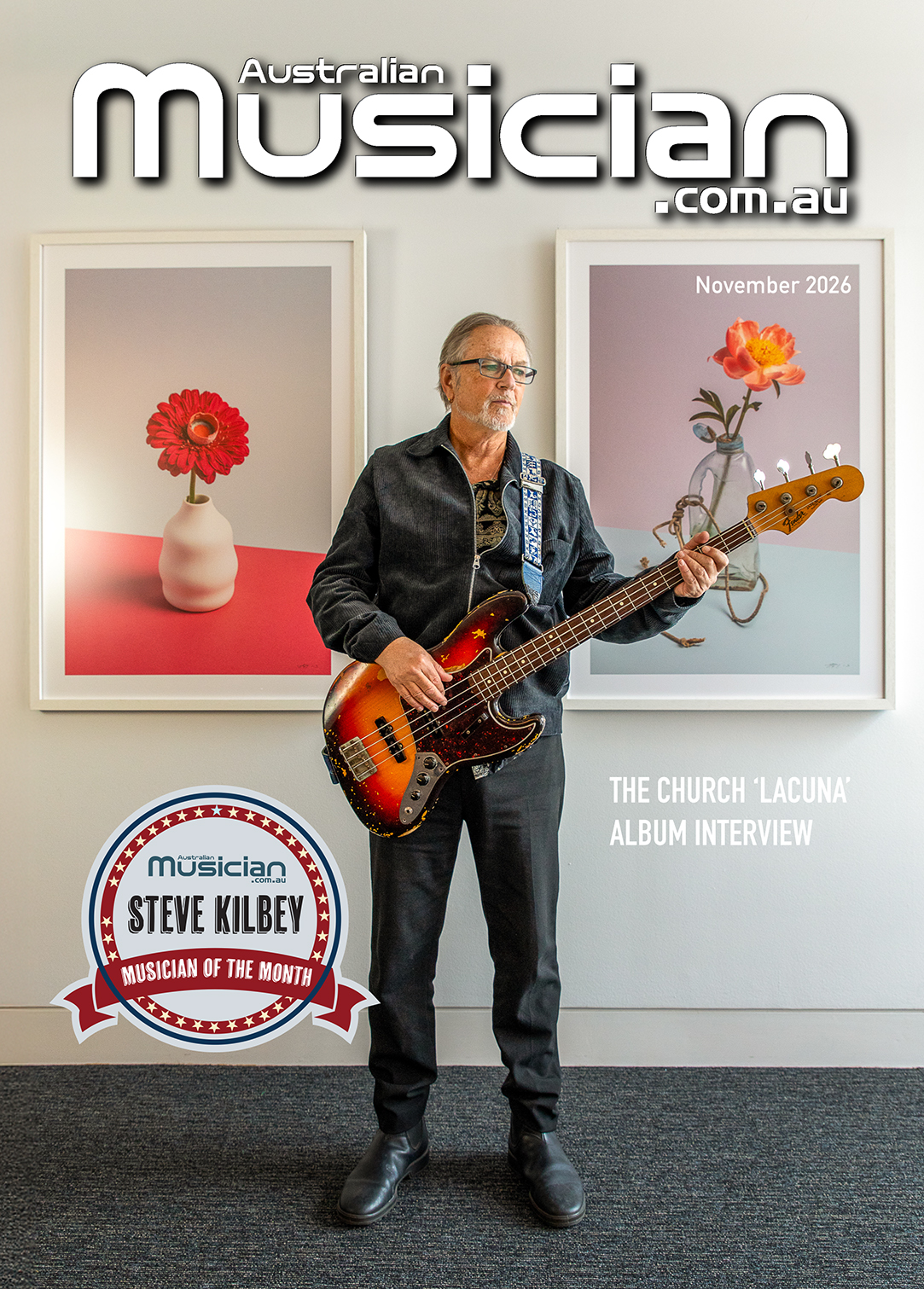
Interview: Greg Phillips. Photos : Jason Rosewarne
In our interview with our Musician of the Month for November, The Church’s Steve Kilbey, he discusses the making of the band’s new 17-track double album, Lacuna (out November 6), offering insights into its creative process, the contributions of the current lineup, his approach to songwriting, and his desire to keep pushing the band forward while balancing audience expectations and the realities of life as a touring musician.
MORE ABOUT THE ALBUM AND INTERVIEW
Recorded in Austin, Texas, over several weeks, Lacuna was made possible by the generosity of a devoted patron who has funded the band’s last three albums. Kilbey describes the arrangement as a modern version of the traditional patronage system, allowing The Church to record without the financial restrictions that might otherwise have limited the project. The patron, a lifelong fan of the band, visited the studio regularly, listened to tracks as they developed and treated the musicians to meals throughout the sessions. Kilbey appreciates the freedom this support provides, while also reflecting on the physical appeal of vinyl records and the sense of substance and artistic importance that comes with owning a double album. Although he acknowledges the convenience of streaming, he misses the experience of holding a tangible piece of music. The double album Lacuna will be available in white vinyl.
A defining characteristic of Lacuna is the band’s willingness to embrace uncertainty during the creative process. Kilbey recalls arriving at the studio with producer Daryl Thorp, whose credits include major international artists, with virtually no prepared material. While this initially surprised the producer, Kilbey was confident that the music would emerge naturally through collaboration. Rather than forcing songs into existence, he trusts the abilities of the musicians around him and believes that creativity can develop from almost any starting point. Some tracks originated in hour-long jams that were edited into shorter compositions before he added vocals, while others began with Kilbey alone on acoustic guitar and gradually evolved as the other musicians contributed. For him, there is no single correct method of songwriting; the important thing is to remain open to whatever approach produces compelling music.
The opening song, “Lumbini Grove,” was inspired by a passage Kilbey encountered in a book about Buddhism while visiting a flotation-tank centre. The location is associated with the birth of Buddha, and its name immediately captured his imagination. He envisioned an idyllic natural environment beside a river, filled with birds, swans and frogs, creating a song about a place where he would like to be. The track’s cinematic introduction features recordings of frogs and other natural sounds. When the engineer played these recordings backwards, they sounded remarkably similar to the originals, inspiring the lyric “Nature in reverse sounds the same.” Kilbey considers the opening and closing tracks of an album particularly important, and the atmospheric beginning of “Lumbini Grove” establishes the mood for the record as a whole.
The first single offered from the album was, “Sacred Echo (Part Two)”, an unconventional choice for a track that runs approximately nine minutes in its entirety on the album but 3 minutes 52 for the single. Kilbey identifies it as his favourite piece of music on the album and had always believed it should be released as a single, despite initial reservations from other band members and people involved in management. The recommendation of a longtime accountant and Church fan reinforced his conviction that the track deserved to lead the release. The decision reflects Kilbey’s willingness to follow his artistic instincts rather than automatically favouring shorter, more conventional material. Elsewhere, he discusses the lyric in “Ferrari” that rhymes “February” with “Ferrari,” acknowledging that some band members were initially dubious. Citing Lou Reed as an artist who demonstrated that songwriting conventions could be broken, Kilbey explains that he now feels free to experiment with language and rhyme. The line is intended to be light-hearted, and he accepts that some listeners may find it amusing while others might consider it excessive. He also clarifies that some of the high backing vocals on “Sky River,” initially mistaken for female vocals, are his own falsetto, with his partner, Rachel, contributing to the track as well.
The conversation also examines how the current lineup shapes The Church’s sound. Kilbey describes Jeffrey Cain as a master songwriter responsible for intricate, interlocking guitar parts that give the arrangements their detailed, almost clockwork-like quality. Ian Haug, formerly of Powderfinger, brings a direct rock ‘n’ roll energy, while Ashley Naylor is the band’s principal lead guitarist, capable of playing in a wide variety of styles. Rather than dictating every arrangement, Kilbey allows the three guitarists to work out their parts among themselves, including deciding who should play particular solos. He sees their ability to collaborate without excessive discussion as one of the band’s greatest strengths, with each musician intuitively understanding what the music requires.
Kilbey’s own bass playing is central to this collaborative approach. He generally develops bass parts early in the songwriting process, using them to establish the chord changes and harmonic direction of a song. He describes the bass as the foundation of a house, with the guitars adding the finer decorative details, and writes bass lines with the vocal melody in mind. The album features two drummers, Tim Powles and Nick Meredith, with Nick contributing more of the recorded drum parts. Kilbey explains that he and the rhythm section rarely discuss their arrangements in detail, instead relying on an instinctive musical connection. The bass and kick drum often lock together naturally, both on stage and in the studio, without the need for explicit instructions. This shared understanding, he suggests, is an essential part of what makes the current band work so well.
One of the interview’s most personal moments comes when Kilbey discusses his main bass, a Fender Jazz Bass designed to replicate the feel and appearance of a vintage 1955 instrument. After losing his collection of basses during his heroin addiction throughout the 1990s, he returned to touring with a borrowed instrument. When he needed a replacement, he initially struggled to find a new bass that felt right until Fender introduced him to the specially aged model. He was immediately drawn to its worn feel and the sense that it possessed the character of an old instrument. Having played it for approximately 25 years, Kilbey has developed what he describes as an almost mystical relationship with it. When he feels uninspired during rehearsal, the bass can seem difficult and unresponsive; when he is enjoying himself on stage, it feels as though the instrument plays itself. Although he acknowledges that this might sound fanciful, he genuinely believes the instrument has absorbed something of the experiences, effort and emotion invested in it over thousands of hours of playing. He also expresses admiration for the enduring design of the Fender Jazz Bass, arguing that despite enormous technological advances in other fields, the fundamental instrument remains remarkably difficult to improve upon.
Despite his enthusiasm for Lacuna, Kilbey recognises that performing the album in its entirety presents practical challenges. He would love to play the record from beginning to end in theatres, followed by a selection of the band’s best-known songs, but he understands that audiences often prefer familiar favourites. He recalls the disappointment of some concertgoers when The Church previously performed their album Further Deeper in full, with audience members wanting to hear songs such as “Under the Milky Way” instead. For Kilbey, this highlights the tension between artistic ambition and commercial reality. He wants the band to continue moving forward creatively, but accepts that what he would most like to do is not always commercially viable. Nevertheless, the band has already begun learning “Sacred Echo (Part Two)” for live performance, and Kilbey was encouraged by how naturally the lengthy track came together in rehearsal. Unlike the band’s early material, which was often performed live for months before being recorded, the songs on Lacuna were constructed in the studio and had never previously existed as fully formed live arrangements. He believes the musicians can successfully adapt them for the stage and would relish the opportunity to tour the album as a complete work.
Our interview presents Lacuna as both a musical statement and an expression of Steve Kilbey’s enduring creative philosophy. The album reflects a band comfortable taking risks, trusting improvisation and allowing individual musicians to shape the music collectively. Its extended compositions, atmospheric arrangements, unconventional lyrics and experimental approach demonstrate that The Church remain interested in discovery rather than simply reproducing their established sound. Kilbey emerges as an artist who values intuition over rigid planning, collaboration over control and artistic freedom over commercial convention. His affection for vinyl and vintage instruments connects him to the physical traditions of music-making, while his embrace of experimentation and spontaneous songwriting shows that he remains open to change. At the heart of the conversation is the tension between his desire to keep moving forward creatively and the reality that audiences often want to look back. Kilbey understands the appeal of the band’s classic catalogue, but his enthusiasm for Lacuna makes it clear that his strongest motivation remains the possibility of creating something new. The album is a testament to his belief in the creative process, the musicians around him and the idea that meaningful music can emerge even when a band begins with nothing. Despite the passage of time and the health challenges ahead (he’s worried about his ‘ticker’), Kilbey remains determined to keep creating, performing and exploring for as long as he can.
Lacuna is relaesed on Friday 6th November, 2026. www.cookingvinyl.com
Follow The Church Website I Instagram I Facebook I Twitter I YouTube
UPCOMING SHOWS
A Psychedelic Symphony will see THE CHURCH joined by a 30 Piece Symphony Orchestra under the baton of celebrated conductor and composer GEORGE ELLIS. Together they will perform an epic orchestral set as they reimagine and enhance their beloved songbook including Under the Milky Way, The Unguarded Moment, Metropolis, Reptile, Almost With You and more. No ordinary concert, A Psychedelic Symphony is a rare chance to experience the songs you already know and love, added to by suitably grand orchestral arrangements.
A wonderful celebration of the music of one of Australia’s most important bands.
The Church: A Psychedelic Symphony November 2026 Australian Tour Dates
Saturday 7th November GOLD COAST, The Star
Thursday 12th November CANBERRA, Canberra Theatre
Saturday 14th November NEWCASTLE, Civic Theatre
Friday 20th November MELBOURNE, Hamer Hall
Saturday 21st November GEELONG, Costa Hall
Wednesday 25th November BRISBANE, Fortitude Music Hall
Saturday 28th November ADELAIDE, Thebarton Theatre
Tickets: https://metropolistouring.com/the-church-a-psychedelic-symphony/