

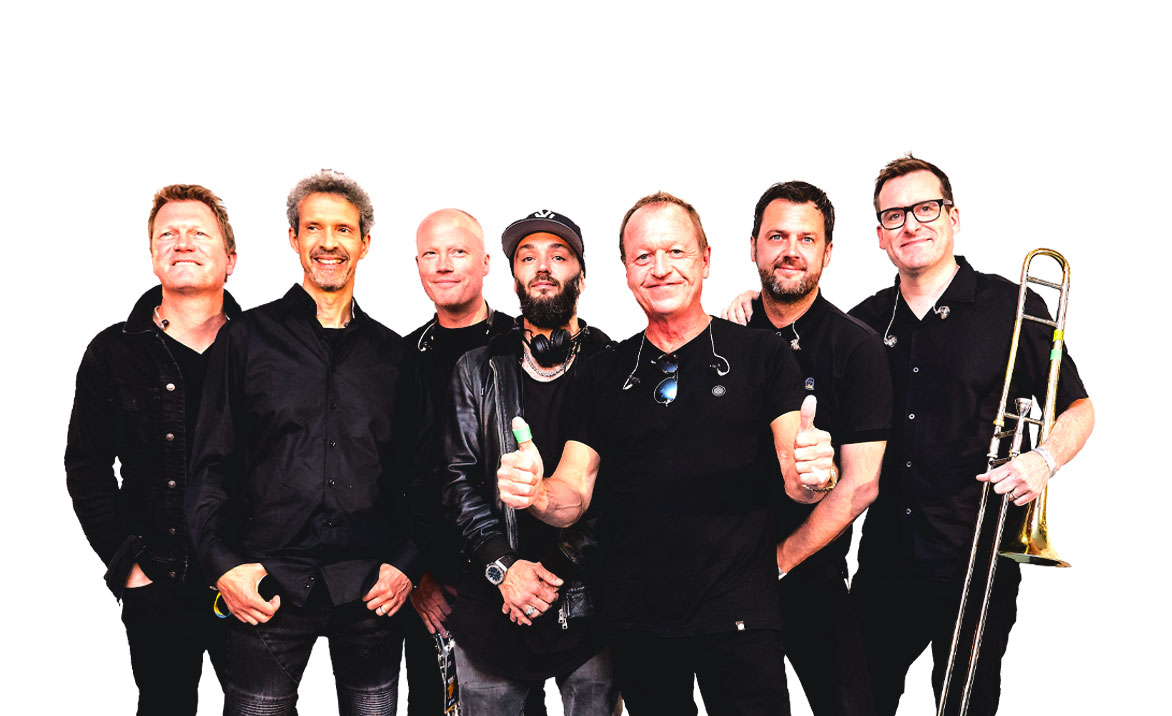
After years of false starts, postponements and a global pandemic that brought the live music industry to its knees, Mark King is finally hoping that Level 42 will make it to Australian shores in January 2027. Speaking from his home on the Isle of Wight, where he has around 22 acres of land to occupy himself with tractors, fences, chainsaws and diggers, the legendary bassist is characteristically relaxed about life at home, although as admits to Australian Musician editor Greg Phillips, COVID was a very different experience for him as a working musician.
“I’m normally very happy being at home,” King says, but when the pandemic hit, his “day job” simply disappeared. Level 42 had been preparing for an Australasian tour in 2020, with Australia, New Zealand, Japan and Indonesia all on the itinerary, only for everything to be repeatedly pushed back. What made the experience particularly difficult, he recalls, was the uncertainty. Six-week postponements became longer delays, with nobody knowing when touring might resume. For King, that uncertainty became frustrating and, at times, quite depressing. He also saw first-hand the enormous impact the shutdown had on younger musicians, including his daughter Marley, who is also a musician. Artists who had spent years making albums suddenly had no way to tour and promote them, while the wider infrastructure supporting live music was being dismantled. Promoters, venues, lighting companies, trucking firms and other suppliers went out of business, and when the industry began to recover, the costs of putting a band on the road had increased dramatically. King estimates that touring costs rose by around 30 per cent, while performance fees often remained at levels agreed years earlier.
WATCH THE INTERVIEW HERE
MORE ABOUT THE INTERVIEW
It’s a sobering reminder of just how complicated touring has become, but King is far more upbeat when the subject turns to Australia. This isn’t the first time Level 42 have attempted to get here. The band was originally due to visit during its commercial peak in 1987, but a change in the lineup, including the departure of brothers Phil and Boon Gould, put an end to that opportunity. There have been other attempts since, and King points out that several planned visits have fallen through through circumstances beyond the band’s or promoters’ control.
Now, finally, he is hoping the stars align. “We are very, very excited to be coming out finally,” he says, before adding with a laugh that he hopes the band’s demographic is still around when January 2027 arrives.
For Australian fans, the setlist should offer considerably more than a straightforward anniversary show. Level 42 recently celebrated the 40th anniversary of World Machine by performing the album in its entirety, but King says they won’t be doing the same thing in Australia. Instead, the album will provide part of a much broader career-spanning set.
World Machine was a pivotal record for the band. By the time they reached their fifth album, they had spent years developing their musicianship and songwriting, evolving from a group of friends primarily writing instrumental jazz-funk into a band capable of crafting sophisticated pop songs with international appeal. “Something About You” proved particularly significant, helping Level 42 break through the jazz-funk label that had followed them during their early years.
That song will be joined by “Leaving Me Now” and perhaps one or two other tracks from World Machine, but King is conscious that the band has too much material to spend an entire concert revisiting one album. The following record, Running in the Family, was even more commercially successful and produced some of Level 42’s most recognisable songs, including “Lessons in Love”, “Running in the Family”, “It’s Over” and “To Be With You Again”.
The set could reach even further back. King singles out “Love Games”, from 1981, as perhaps the clearest representation of what Level 42 is all about. The song established the rhythm section as a central part of the band’s sound, with King’s bass and Phil Gould’s drumming providing the foundation while vocals were shared between King and Mike Lindup.
“Starchild” will also feature, a song King describes as a great example of the band’s studio collaboration with percussionist Wally Badarou. Ultimately, the Australian shows are likely to draw from across roughly 15 years of Level 42’s history, with the set carefully constructed around the dynamics of a live performance.
For King, putting together a successful show isn’t simply about cramming as many hits as possible into 90 minutes. The set needs to rise, fall and build again, eventually finishing with the band “steaming out with all guns firing”. It’s a formula he believes works for the audience, judging by the response they’ve received over the years.
The ritual immediately before the show is considerably simpler. The members of Level 42 shake hands before taking the stage while an introductory tape, incorporating themes from their songs and marching drums, gets them into the mood. Despite his decades of experience, King says that the nervousness of walking onstage never completely disappears.
He remembers playing bass in the house band for the Prince’s Trust shows in 1985 alongside a remarkable cast of musicians, including Elton John, Eric Clapton and Phil Collins. As the musicians waited backstage at Wembley Arena, King looked down the line and noticed something reassuring, the biggest stars in the room appeared to have exactly the same look of fear in their eyes that he did.
No matter how experienced you are, there is still that moment before walking onto a stage when you wonder whether you can do it one more time.
That attention to detail extends into the band’s soundchecks. Level 42 soundcheck every show when they have the opportunity, with the first few performances of a tour generally involving longer sessions as arrangements, monitors, lighting and front-of-house settings are refined. Once everything is dialled in, the process can be completed in around 20 minutes.
They always begin with “Starchild”, largely because the song contains so many different elements. Brass, backing vocals, percussion and the rest of the band’s instrumentation all come into play, making it an ideal track for balancing the system. The soundcheck then finishes with the beginning of the actual show, allowing front-of-house engineer Mark Clemens to have the levels prepared for the moment the band walks onstage.
King has embraced the practical advantages of in-ear monitoring, particularly at festivals, where Level 42 can bring its own monitor desk and recall familiar settings. But given the choice, he still prefers wedges. Part of the reason is simply the sound, but there’s also the connection with the audience. In-ear monitors can isolate a performer from the room, meaning that King can sometimes finish a song thinking the audience has been relatively quiet, only to remove his in-ears and discover that the venue is actually roaring.
He once tried adding audience microphones to his in-ear mix to address the problem, but the experiment quickly became distracting when he began hearing individual audience members’ conversations through his monitors. One person was enthusiastically discussing how many times they’d seen the band, while another was commenting on King’s appearance. “I’ve got voices in my head,” he recalls thinking, before asking the monitor engineer to turn the audience microphones off.
When it comes to bass gear, there has also been something of a change since the pandemic. King is no longer primarily using his Status King basses. During COVID, he rediscovered an old JD Supernatural bass, his original red instrument, serial number 0003A, which had been hanging on the wall in his studio. Picking it up again unexpectedly rekindled his enthusiasm for playing.
He’s still using Markbass amplification, which he says provides everything he needs, together with a Caveman bass preamp featuring high-end compression and a clean preamp stage. His preferred speaker configuration remains 4×10, a setup he has used throughout his career because of the fast response of 10-inch speakers, particularly for the rapid slap-bass technique that has become such a defining part of his sound.
King contrasts his current JD instruments with his Status graphite basses. The Status instruments were virtually bombproof, with carbon-fibre necks that remained remarkably stable regardless of conditions. The JD basses, by comparison, require considerably more attention, with temperature changes affecting the neck and requiring regular adjustments. But King loves the feel of them.
And at 67, there’s something fitting about returning to the type of bass that helped start his career.
The conversation eventually turns to the question of new Level 42 music, something King has been reluctant to pursue in recent years. The biggest obstacle is the loss of his longtime songwriting partner Boon Gould in 2019. King spent much of his songwriting life collaborating with Gould and believes their strongest work came from that partnership. While he has written material on his own, he has never felt that it quite matched what they created together.
There is also the problem of an enormous back catalogue competing for space in an already crowded 90-minute show. If Level 42 were to arrive in Australia with an album of completely new songs, King suggests that some fans might understandably feel they had missed out on the classics they came to hear. There are simply too many songs people expect to hear and not enough time to play them all.
And, as King points out with typical humour, Level 42’s music is not exactly sparse. Ninety minutes represents a lot of notes.
For now the focus is on getting back on the road and, finally, getting to Australia. After multiple cancelled attempts, a pandemic, a changing music industry and years of waiting, King is clearly eager to step onto an Australian stage at last. The promise is a set that reaches across Level 42’s history, from “Love Games” and “Starchild” through World Machine and Running in the Family, delivered by a band that has spent more than four decades refining the art of playing live.
“I can’t wait,” King says at the end of the conversation. “Let’s hope it happens!”
LEVEL 42 January 2027 Australian Tour Dates
Monday 18 January – Astor Theatre, Perth
Thursday 21 January – The Gov, Adelaide
Friday 22 January – Palais Theatre, Melbourne
Sunday 24 January – Enmore Theatre, Sydney
Wednesday 27 January – Fortitude Music Hall, Brisbane
Tickets: https://www.destroyalllines.com/tours/level-42