
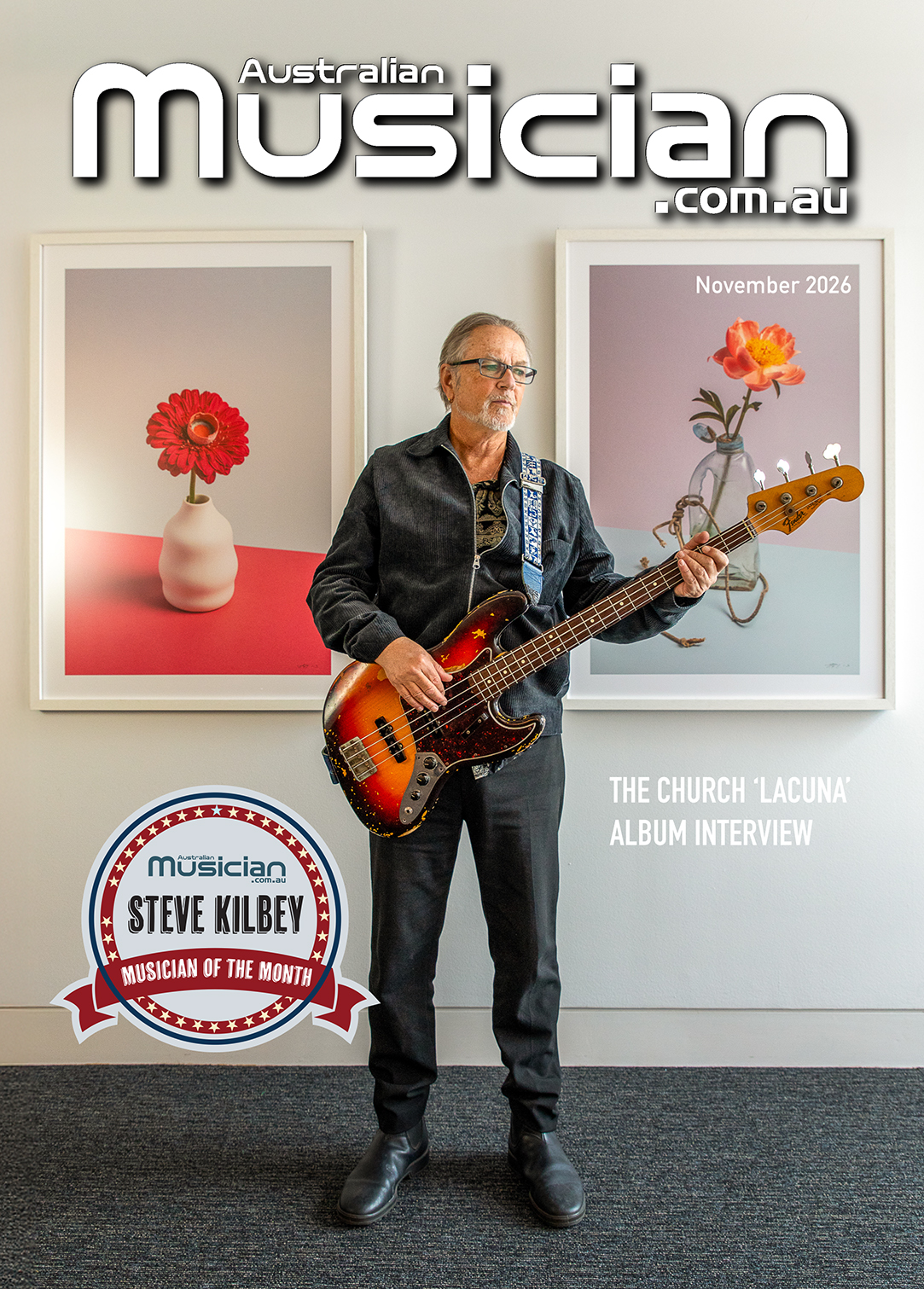

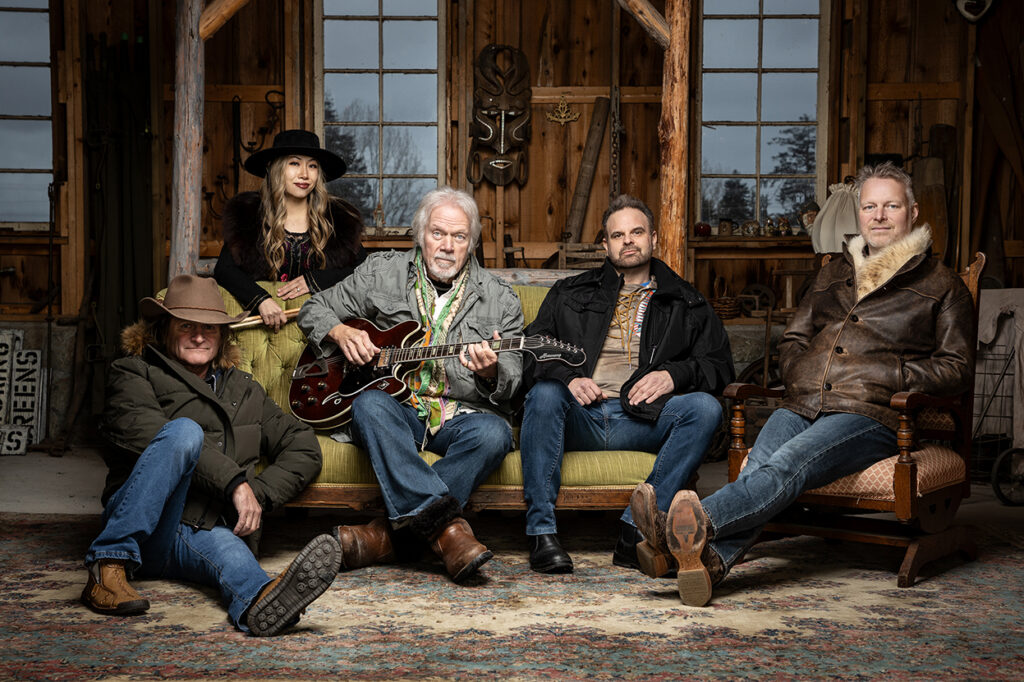
Australian Musician editor Greg Phillips speaks with legendary Canadian musician Randy Bachman ahead of his first-ever Australian tour in February 2027. From the enduring hits of The Guess Who and Bachman-Turner Overdrive to the remarkable stories behind Takin’ Care of Business, Bachman reflects on a lifetime in rock ’n’ roll, family, guitars and the music that continues to connect generations.
Australian Musician: Randy Bachman, welcome to Australian Musician Magazine. You’re coming to Australia in February 2027 for the very first time. The obvious question is … why has it taken so long?
Randy Bachman: The obvious answer is that we were busy! We’ve always been a family band, which means that when you’re on the road, your family’s at home, and you can’t go everywhere when you have a worldwide hit like we had in the mid ’70s. Everybody wants you everywhere. I had two marriages and I was never home and Australia was my third wife!
Australian Musician: Obviously, you were aware that you were having hits down here?
Randy Bachman: Oh yeah.
Australian Musician: Let’s talk about the current show. You play a mix of Bachman-Turner Overdrive and Guess Who songs. What’s the goal every time you hit the stage?
Randy Bachman: It’s quite a thrill to do stuff that you wrote as a teenager, hoping it would get played on the radio, and then suddenly you’ve got about 20 songs that everybody knows, decades later. We look out into the audience and see eight and ten year old kids singing the songs with their parents and grandparents. It’s like a family outing. It’s not rebellious teenagers going to a rock show, it’s families coming to hear the soundtrack of their lives through these songs. We’re very fortunate.
I’ve had a good five or six to ten hit songs that fans want to come and see us perform. If you’re going to see Paul McCartney, you expect to hear a few Wings songs and Beatles songs. We do the same thing, bringing together The Guess Who and BTO catalogues. We also perform songs from the later BTO years. My son Tal has now joined the band. I lost my three brothers during COVID, and Tal kind of grew up around the band, so him being in it is a very natural thing.
Australian Musician: Your daughter-in-law is in the band as well. That’s quite a family affair!
Randy Bachman: Yeah, pretty amazing. When my brother passed away, my son got married to a Japanese woman, and she said, “I’m a drummer.” You know, you’re a guy and you go, “Yeah, yeah, a girl drummer!” But she explained that she’d been playing drums for years. Her father had seen BTO at the Budokan and brought home an album. He told her she should learn to play like that.
She said, “I play just like your brother.” I asked what she meant, and she said, “I channel him. I go to my God. I listen to the music and channel your brother Robbie.” Robbie was a very unusual drummer because he never had an actual drum kit when we were growing up. We couldn’t afford one, so he played in our kitchen on upside-down pots with wooden spoons. We had a big round Quaker Oats container, and he’d use that too.
When we recorded our first album, we didn’t even have a proper drum kit. I told him, “Play like Ringo. Just keep a beat, a nice solo, and he’d throw in a little John Bonham or Keith Moon once in a while.” Then I realised he was a left-handed drummer playing a right-handed drum kit, so his Ringo Starr-style rolls were backwards!
My brother was ten years younger than me, but he … wanted to be better than me, so every time I played a thick guitar solo, he’d answer with a drum roll.
A lot of my guitar solos are like a conversation between the guitar and drums. There’s a call and response. When I play something like “Roll On Down the Highway”, Koko has this unusual way of answering my guitar lines. It makes my solos sound better because the guitar and drums are almost singing together. Robbie also played a lot of tom-toms. He was very hip. So when I heard my daughter-in-law play, I said you passed the audition, I could hear that connection. She plays with that same spirit.
Our manager came in from LA and said, “You’ve got to put Koko on a higher drum rise.” Everybody watches her because she’s got this gigantic head of hair, and she’s only about four foot eleven! She’s a very animated drummer. When I introduce her as Boom Boom Bachman, the Rolling Thunder on drums, the women in the audience go crazy. She’s this little thunderbolt standing next to us, making a sound like Keith Moon or John Bonham. She’s a very powerful player and practices hard every day. She’s become the engine of the band.
Australian Musician: You played with Ringo Starr in his All-Starr Band. Were you thinking about your brother when you were playing alongside Ringo on stage?
Randy Bachman: I certainly was. When Ringo was playing Takin’ Care of Business with me, he was doing those drum rolls that my brother had been emulating all those years. Here I was, playing with Ringo, and thinking about Robbie and all those great memories.
Australian Musician: Do you recall the first time you heard one of your songs on the radio?
Randy Bachman: Yeah, we pulled over and cried. We were driving, and I must have been about 17. We’d cut a song Shakin’A ll Over that became a local hit, but later, when we were making records in New York with Phil Ramone producing, we heard one of our songs on the radio and pulled over. We were shaking. We were finally on the radio, and it wasn’t even in our hometown. It was Toronto!
It’s like being an American guy living in some little town in Iowa and suddenly hearing yourself on New York or Chicago radio. That day, we were heard on Toronto radio, then Vancouver radio, and eventually LA radio. Our teenage dream was coming true.
Australian Musician: One of the things I think is missing with a lot of artists these days is that they don’t have great stories to tell. One of the best rock ‘n’ roll stories I’ve heard is how the piano track on “Takin’ Care of Business” came about. A pizza delivery guy came to the studio with a pizza, asked if you could give him a break and play piano on a track, and you let him do it. Could you indulge me and complete that story?
Randy Bachman: It’s a long story. The song took about eight years!
I started writing the song in the ’60s, when I heard “Paperback Writer”. I was inspired by the way songs could tell stories. I was recording in a studio in New York owned by Florence Greenberg, who managed Dionne Warwick, Chuck Jackson, Whitney Houston’s mother Cissy, a lot of artists and songwriters. Her son Stanley was the engineer.
I wanted to write something about a white collar worker. I started talking to Stanley about his life, he was blind. This was New York in August. It was 95 degrees with 95 per cent humidity. We were all wearing cut-off shorts and ripped T-shirts. Stanley would come through every day wearing a white button-down shirt, a tweed jacket, a wool tie and wool pants.
I asked him, “Stanley, why do you dress that way?” He said, “I want to look like the greatest studio engineer in the world.”
I told him he looked like a hot mess and asked why he didn’t take the jacket off. Every day he would leave at 10 o’clock. He went home every night at ten. I asked him how he managed that. I said your mother owns the studio, why don’t you stay here?
He said, “I take the bus. I’m blind, but I’m not handicapped.” He would walk to Grand Central and take the bus home. I asked him how he got to the station. He said he walked. He knew exactly where he was going. He’d count 385 steps, listen for the pedestrian crossing signal, cross the street, and then count another 85 steps.
I asked him what happened when he got to Grand Central. He told me that at night the streets were empty, but in the morning the trains were full of people coming into the city. The women were putting on their makeup, trying to look pretty. He could smell lipstick, perfume and hairspray. I thought, “That’s it! That’s what I want to write about.”
The idea became a song about the white-collar worker going into the city every morning. I said, “Stanley, what happens in the morning?” He said “I take the 8.15 into the city. People are pushin’ and shovin’ and you know, the girls are trying to look pretty!” I came to my hook and singing ‘White Collar Worker’, you know like ‘Paperback Writer’. I had the verses, they were great but everyone hated the chorus and the song never really came together. I’d tried to get it onto several albums over the years, but it never made it.
Then one Saturday night, we were playing in North Vancouver, doing six nights a week … five 50 minute sets. By Saturday, we were exhausted. Fred Turner came up to me and said “I can’t sing anymore.”
We had to play a full 50-minute set because if you cut your set short in those days, they’d cut your money. I wasn’t really a singer and I was thinking about what to play. I wanted to do something different, and suddenly I remembered that unfinished song about the white-collar worker. On the way to the gig that night we were listening to the radio and this DJ comes on and says it’s DJ Daryl B here and we’re taking care of business. I just thought, that’s a song title.
So at this gig I thought, “What if I play White Collar Worker? What if I take out ‘white collar’ and put in ‘takin’ care of business’?” I stripped the song down to three chords, turned around to the guys and started playing it. They followed me. When I got to the hook, the band asked what I was singing. I told them, “Just follow me.” I sang the verses and then got to the chorus and sang Takin’ Care of Business, and it fitted perfectly. The next time around, the audience sang it back to me. I answered them with “Every day, every way”, and suddenly we had something. I said thank you angels of song. The song had been in the making for six or seven years.
A few weeks later, we went into the studio. Fred Turner was our singer, and needed a rest from singing all night, so I suggested recording the song as a short track for the end of the album. I sang it once, and we left the studio.
It was about two in the morning when there was a knock at the door. We opened it, and there was this guy standing there in an army shirt, army hat and big beard with black, frizzy hair, holding three pizzas. He asked, “Are you the guy who orderd pizza?’
I said, “No, the studio downstairs. Steve Miller is in there, and then in the other room there’s a band called War”, who were recording Why Can’t We Be Friends.
A few minutes later, he came back and said he was not just a pizza delivery guy but a piano player. He couldn’t pay his rent and had been delivering pizzas. He’d heard the song we were working on and thought it sounded like it needed piano. He asked, “Could you give me a break?”
I thought, who am I not to give a guy a chance? Somebody gave me a chance once and here I am. So I said, “Okay, we’ll give you a shot.” Normally, when you’re recording piano, you spend time getting the sound right, you get it tuned and mike it properly. I threw a mic on the piano and a blanket over it and told him he had one take. We were going home.
I asked him to play a little like Dr John, Elton John and Little Richard. He played the first verse like Elton John, with some unusual chords. The second verse was like Dr John, with that real New Orleans feel. Then he played the ending like Little Richard, with those rock ‘n’ roll piano flourishes. I liked that version better, so we kept it. He played it once, and we went home. I never even heard it back.
The next day, the head of our record label came to hear the album. He’d been asking me to write more Top 40 songs like the ones on our first BTO album. We were playing the album, and I told him, “When you get to this song, don’t play the piano part.”
Halfway through, he stopped and said, “What is that? BTO with a piano? That’s amazing!” He pointed out that we were competing with bands like ZZ Top, Doobie Brothers and Aerosmith. They were all guitar and drum bands. Elton John owns real estate on AM radio and FM radio with his piano.
He asked, “Who’s playing the piano?”
I said, “I have no idea. The pizza guy delivered pizza, asked for a break, and I gave it to him.” He couldn’t believe it. He told me we had to find the guy because he needed to be credited. He said play me the whole track and he said that’s fantastic, you’ll be singing that song the rest of your life. So I went to the studio with the Yellow Pages and asked them to find the pizza delivery guy. We started calling the pizza places in the neighbourhood, looking for someone with a big frizzy beard, that looked like Fidel Castro.
Eventually, we tracked him down. His name was Norman Durkee He got his break, and he went on to become a musical director with Bette Midler. Years later, when I was playing with Ringo’s All-Starr Band, we came back to play in LA at a theatre where the LA Philharmonic rehearse. The piano player was Durkee, I got to meet him again. People love that story. The pizza guy playing piano on Takin’ Care of Business, one take!
Australian Musician: A couple of years ago, you auctioned several of your guitars. Do you still have a decent collection? What have you kept?
Randy Bachman: I’ve got well over a 100 left.
In the middle of COVID, I was diagnosed with four cancers. My immune system was over and they gave me two to four weeks to live. They told me to go home and put my affairs in order. It was Christmas Eve, a couple of years ago. I called all my kids. I’ve got eight children, and I told them I probably wouldn’t be here for Valentine’s Day. I said, “I’ve got cancer, and I’m in a pretty bad way.”
Of course, everybody was sad. I told them they could come and pick up a guitar, but they said, “We’re not guitar players!” They suggested that if I passed away, the guitars would just get left behind, so why not sell them? To be honest, we’d appreciate the money.
So I put them up for auction. But I lived! I had chemo, and I’m perfectly healthy now and want my guitars back!
I sold my 350 red Gretsch. There’s now a book about the Randy Bachman Gretsch collection, and a documentary has been made about it. My original orange 6120 Gretsch was stolen in 1967 and lost for 48 years. I tried to get it back, but couldn’t, until we started doing live YouTube shows during COVID.
I saw a guy playing my guitar on YouTube. He’s playing like Brian Setzer, playing Rock This Town but singing phoenetically. My Japanese daughter-in-law Koko went to his website, but there was a language barrier. He didn’t speak English. His name is Takeshi. So he is a good friend now but I can’t talk to him!
We eventually made contact, and I’m going back to celebrate getting my guitar back this weekend. We’re also finalising the documentary about its return after 48 years and the journey it took during that time.
It’s also very weird that George Harrison got his Gretsch back, Peter Frampton got his Les Paul back, and other musicians have had similar experiences. We’re all getting our stolen instruments returned after 50 or 60 years. There’s this karmic cycle where people who have had these stolen items are feeling guilty. John Fogerty’s wife got his Rickenbacker back for his birthday. It’s really exciting.
Australian Musician: What are you touring with now, and what are you likely to bring to Australia?
Randy Bachman: When I got back with BTO, I got a call from Gibson asking why I wasn’t using my ’59 Les Paul, the classic American Woman sounding guitar. I explained that it weighed 14 pounds. It was too heavy. I only played it sitting down in the studio. You can’t play something that heavy on stage for three hours a night.
As the decades go by, you start to feel it in your spine. So they asked what I needed, and I said I wanted something half the weight. We’d just made one for Steve Lukather as his back up. They said we can make you a lighter Gibson, we could chamber it out, and they made me a guitar weighing about 7.8 pounds. I’ve been playing that one ever since. They also made me a gold-top version. So I’ll be bringing those guitars to Australia. They’re my main go-to instruments.
Australian Musician: Randy, what are you looking forward to most about the Australian tour?
Randy Bachman: I’ve never been there! My son Tal has been there quite a bit because they’ve held shows there, so he’s looking forward to going back.
I’m looking forward to meeting the people. Australia has such a rock ‘n’ roll vibe, you know what I mean? There’s the AC/DC connection, and I’m a Canadian musician who grew up with all that great music. I grew up with Split Enz. Canadians are into Australian and New Zealand music. The Easybeats, Friday On My Mind … the Young family! I’m looking forward to the rock ‘n’ roll audience, the fans who know the songs, and the younger fans who are discovering the music.
Australian Musician: It’s been an absolute honour to chat with you, Randy. We look forward to seeing you in Australia very soon.
Randy Bachman: Thank you for your time. We’re coming to Oz! Be there or be square!
Australian Musician: Thanks, Randy. Thank you very much.
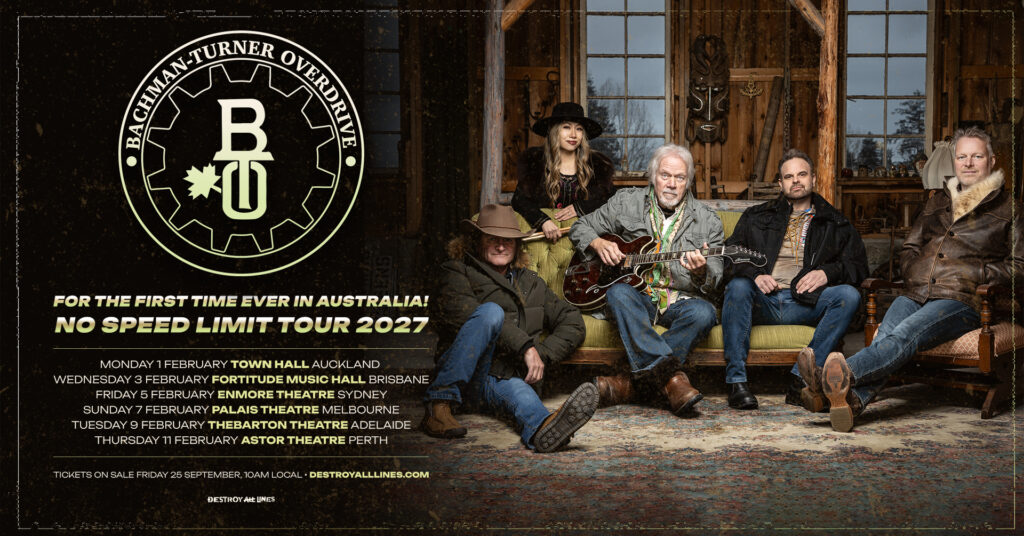
Bachman-Turner Overdrive Announce Their Very First Australian Tour With ‘No Speed Limit’ Dates – February 2027 After decades of waiting, Australian rock fans will finally witness one of music’s greatest live rock experiences when Canadian rock icons Bachman-Turner Overdrive arrives in February 2027 for an unmissable tour of all capital cities. This is the moment fans have been waiting for. From the iconic “You Ain’t Seen Nothin’ Yet” (a #1 hit in over 20 countries) to the legendary “Takin’ Care of Business,” “Let it Ride,” and “Roll on Down the Highway,” BTO will deliver the ultimate rock setlist that defined a generation.
Wednesday 3rd February Brisbane Fortitude Music Hall
Friday 5th February Sydney Enmore Theatre
Sunday 7th February Melbourne Palais Theatre
Tuesday 9th February Adelaide Thebarton Theatre
Thursday 11th February Perth Astor Theatre
destroyalllines.com