
Chris Porcianko on Eremition, creative renewal and the band’s next chapter
Interview by Nick Tevelis
For more than three decades, Melbourne’s Vanishing Point have been one of the most enduring and respected names in Australian melodic metal. Renowned for their soaring melodies, powerful guitar work, progressive influences and unmistakable sense of musical grandeur, the band has carved out an impressive legacy both at home and internationally, earning a fiercely loyal following along the way.
From their early beginnings in the mid-1990s, Vanishing Point have taken Australian metal to some of the world’s biggest stages. Career highlights include an appearance at Germany’s legendary Wacken Open Air festival, European tours alongside Gamma Ray and Sonata Arctica, and sharing stages with international heavyweights including Iron Maiden, Helloween and Nightwish. Across six studio albums, from their 1997 debut In Thought through to 2020’s Dead Elysium, they have consistently demonstrated an ability to balance musical sophistication with memorable songwriting and genuine emotional depth.
Now, six years after their last studio release, Vanishing Point are preparing to unleash their seventh album, Eremition, worldwide on Friday, November 20, 2026. And for those who have followed the band’s journey, the wait promises to have been well worth it.
Eremition captures everything that has made Vanishing Point such a compelling musical force while pushing their sound into exciting new territory. The album delivers the expansive, cinematic arrangements and soaring melodies that have become the band’s trademark, alongside some of their heaviest and most atmospheric material to date. From the infectious melodic rock sensibilities of lead single ‘Bring Me the Night’ and the thought-provoking ‘Sirens’, through to the intensity of ‘Faultline’ and ‘The Faceless’, and the haunting, doom-laden title track, Eremition is an album of remarkable variety, depth and maturity.
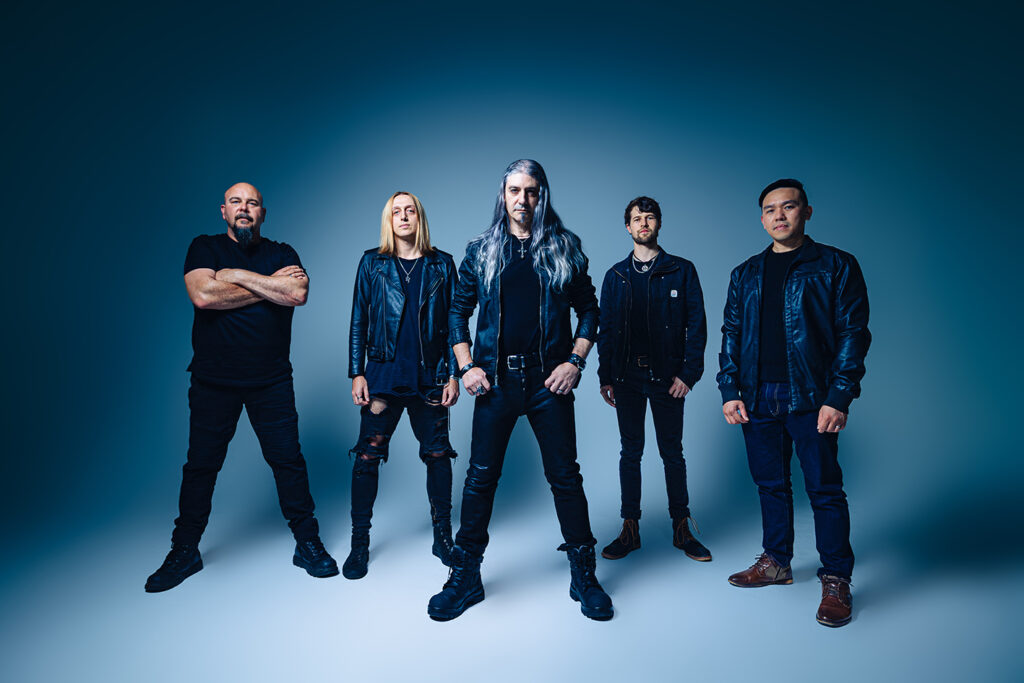
Importantly, it also sounds like the work of a band with renewed sense of purpose. Despite the lengthy gap between releases, lineup changes and the inevitable challenges that come with balancing music and everyday life, guitarist and principal songwriter Chris Porcianko and vocalist Silvio Massaro remain the creative heart of Vanishing Point. Together with guitarist Ande Falko, bassist Gaston Chin and drummer Damien Hall, they have emerged with an album that feels both reassuringly familiar and refreshingly different.
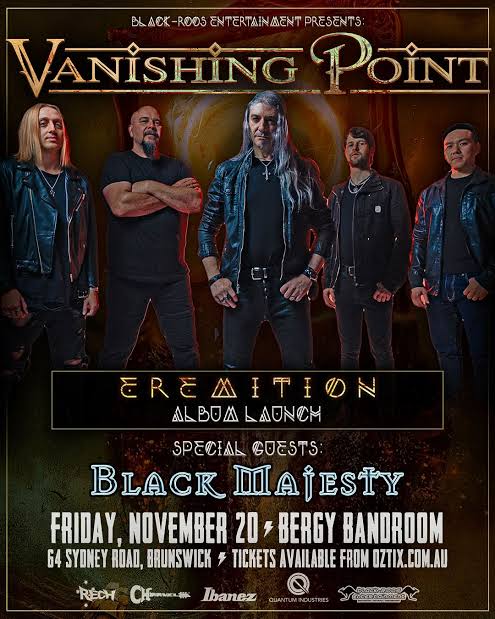
To celebrate the release, Vanishing Point are returning to the stage for two special November performances. First up is an appearance at Sydney’s Steel Assassins festival at The Bridge Hotel on Saturday, November 14, marking the band’s return to the city after seven years. Sydney audiences can look forward to hearing new material alongside favourites from the band’s extensive back catalogue.
But the biggest celebration is reserved for their hometown.
On Friday, November 20, the very day Eremition is released worldwide, Vanishing Point will officially launch the album at Melbourne’s Bergy Bandroom in Brunswick, joined by fellow Australian melodic metal stalwarts Black Majesty. It’s a fitting occasion for two bands whose contributions to the local metal scene have been considerable and promises to be a memorable night for fans of powerful, melodic heavy music.
With seven albums now spanning almost three decades, the evening presents an opportunity to celebrate not only the arrival of Eremition, but also the extraordinary body of work Vanishing Point have assembled along the way. For longtime followers, it’s a chance to reconnect with one of Australia’s finest melodic metal bands. For those yet to experience Vanishing Point live, there could hardly be a better introduction.
Ahead of these shows and the release of Eremition, I caught up with Chris Porcianko for an extensive conversation about the band’s enduring legacy, the creative journey behind the new album, the stories and inspirations driving its songs, and the renewed energy within the Vanishing Point camp. As always, Chris was generous with his time, candid in his reflections and refreshingly passionate about his craft.
Almost thirty years into his own journey with Vanishing Point, it’s clear that neither Chris nor the band are showing any signs of slowing down.
AUSTRALIAN MUSICIAN: You’ve been part of Vanishing Point since 1997. In that time, the band has weathered line-up changes, lengthy gaps between releases and enormous changes in the way people discover and consume music. What has kept your passion for Vanishing Point alive for almost three decades, and what still excites you about making music with this band?
CHRIS PORCIANKO: I just love creating. I love playing music live, but I also enjoy the challenge of writing music. Sometimes the ideas don’t come easily and you really have to work at something for it to turn out okay. Then, when you least expect it, you can write a complete song in half a day. I love that spontaneity.
That’s probably what keeps me interested and gives me the passion to do what I do after all these years.
AUSTRALIAN MUSICIAN: Before the album came out, you were sharing snippets of new music online and giving people a glimpse of the creative process. Listening to the finished record, I recognised passages you’d posted when they were still ideas. Was it a conscious decision to let people into that journey more than you had in the past?
CHRIS PORCIANKO: I’ve always liked sharing a little bit of the journey. It gives people an insight into why I still enjoy doing this after all these years. I’m not an overly private person when it comes to music. If someone asks me a question, I’m not a gatekeeper. I’m happy to pass on any knowledge or information I have, and to share the joy I get from creating music. That’s important to me.
AUSTRALIAN MUSICIAN: That idea of a journey leads nicely into something else I’ve noticed. Looking back at albums like Tangled in a Dream, Embrace the Silence and Distant Is the Sun, Vanishing Point seems to have moved from its progressive metal beginnings towards an increasingly melodic, cinematic sound. Was that a conscious direction, or more a reflection of how you’ve developed as a songwriter and musician?
CHRIS PORCIANKO: I think it’s the latter. Around 2010 I started getting into home production and writing on the computer. I was late to the party, but suddenly I could take the ideas in my head, build them at home and then bring them to the guys.
I do a lot of writing and recording at home, using different plug-ins, especially orchestral ones. I enjoy incorporating those sounds into the music, and that has naturally changed the sound. The melodic emphasis is still there, particularly because we have Silvio as a vocalist. We just want to write good songs—whether they’re melodic, progressive or metal. A good song is a good song, regardless of genre.
AUSTRALIAN MUSICIAN: Speaking of good songs, Eremition is full of them. I’ve lived with the album for a few weeks now and thoroughly enjoyed it from start to finish. It’s been six years since the last record, and you’ve always put quality ahead of quantity. What was happening creatively during those six years? Did the songs develop steadily or come together in a burst—and was there ever a moment when you wondered if another Vanishing Point album would happen?
CHRIS PORCIANKO: There was never a question of whether there would be another Vanishing Point album. There were delays, including line-up changes, but the intention was always there.
The songs and the concept for Eremition were actually completed in pre-production about three years ago. So when someone tells me they really like the album, that’s great—but I’ve been sitting with these songs for a long time! Musicians often have their material around for quite a while before anybody hears it.
In some ways the recording itself was a quicker process for us. It was other things that held up the release: life, work commitments and changes in the band. A band can be like a marriage. Sometimes things don’t work and you have to return to the drawing board and remind yourself why you started.
I found some clarity in that. I’ve always enjoyed creating music, but with the team we have now I’m really enjoying the whole process of being in a band again.
AUSTRALIAN MUSICIAN: One of the things that stands out on Eremition is its range: the sweeping melodies of ‘Bring Me the Night’ and ‘The Other Side’, the heavier attack of ‘Faultline’ and ‘The Faceless’, and the darker atmosphere of ‘King of Denial’. Was showcasing those different sides of the band part of the original vision, or did that diversity emerge as the songs developed?
CHRIS PORCIANKO: Not really. There wasn’t a preconceived idea about how the album should sound or what the theme should be. It took shape as we wrote it.
I’ve had some health battles over the past couple of years, and so has Silvio. We’re getting older, our parents are getting older, and life can throw you curveballs. It also teaches you perspective. A lot of the themes come from a personal place and perhaps from searching for some kind of renewal, without malice. I’ve learned that holding on to negativity isn’t good for you. I want to put my energy into the things I enjoy.
One of the liberating things was recording the vocals with Silvio and Dean Wells. Rather than having everything mapped out, we were writing and recording vocals on the fly in the studio. Dean is almost an unofficial member of Vanishing Point. Def Leppard had Mutt Lange; we have Dean Wells! He’s a funny character, a great creative force, and I love working with him.
Going in fresh and seeing what happened was an awesome experience. It reminded me why I do this: the joy of being creative.
AUSTRALIAN MUSICIAN: I want to talk about what might be my favourite song on the album, ‘Bring Me the Night’. It has a strong melodic rock influence, including those ’80s AOR touches you’ve spoken about. You’ve also discussed the idea of not letting other people’s negativity dictate your direction in life. Did the music or the lyrical idea come first? And what made this the right song to reintroduce Vanishing Point after six years?
CHRIS PORCIANKO: The music came first. Funnily enough, it’s only about a year and a half old and was the last song added to the album. I wanted something straight-ahead and headbanging, with that heavy feel but also the ’80s AOR influence I love.
Despite the references to negativity and being sick of things, it’s actually a fun song. I don’t see it as something people need to analyse too deeply. Someone in America asked me what it meant, and I told him, “It’s whatever you think it is!” It’s open to interpretation. There’s no hidden message; I just want people to enjoy it and hear a different side of Vanishing Point.
AUSTRALIAN MUSICIAN: ‘Sirens’ is the second single from Eremition. You’ve spoken about how technology connects us more than ever, yet we seem to be losing something in terms of empathy and personal connection. You’ve also described it as continuing where ‘Dead Elysium’ left off. How deliberate was that link between the two records? And do these songs reflect a broader frustration with where the modern world is heading?
CHRIS PORCIANKO: It’s about connection and disconnection. People are quick to embrace the latest technology, sometimes without really understanding it, and we’ve become a very throwaway society. At the same time, I feel we’re losing empathy and the habit of looking out for each other. That’s a real bugbear of mine.
“Sirens” is almost a sibling to “Dead Elysium”. I didn’t set out to make it a continuation, but as the song came together it felt like the natural next chapter.
I’m all for technological progress, but as a species we can seem to be regressing in other ways. We’re losing touch with simple things, like offering someone a kind word. Add politics and the instability in the world, and it’s worrying. The song captures those feelings.
AUSTRALIAN MUSICIAN: The album closes with ‘Eremition’, a doom-laden track unlike much of what Vanishing Point has recorded before. Where did the inspiration to take the music in that direction come from? And why did you feel this song should carry the album’s title and provide its final statement?
CHRIS PORCIANKO: It sat in my project folder for years under the name “doom tune”! It started with just two chords in D minor. I can write riffs and technical parts, but I wanted to strip this one right back. The melody gradually emerged and it developed into a big soundscape.
I wanted to capture the deeper side of Silvio’s voice and make something atmospheric rather than just another metal song. We’ve had serious songs, fun songs and uplifting songs over the years. This one was deliberately cinematic and dark.
It was probably the one track where I had a fairly clear idea of how it might develop. I’m really happy with the result and with how different it is from the rest of our catalogue. I wasn’t forcing myself to do something different—it just happened.
AUSTRALIAN MUSICIAN: I’m particularly intrigued by the track ‘A Year Turns to Nine’. It sounds as though there’s a very specific story or personal experience behind it. Without sharing anything you’d rather keep private, what’s the significance of that title, and what does the song mean to you?
CHRIS PORCIANKO: It’s probably the most political song on the album, although I was interested in the human story rather than making a party-political statement. I’d read about a refugee—I think he was from Afghanistan—who came to Australia and was kept in hotel accommodation that was meant to be temporary.
He was cut off from the outside world and had no clear idea when he might be released or granted a visa. What was supposed to be a short stay stretched into years. I wrote the lyrics as though he were writing letters to his family back home, trying to express that emptiness and desperation.
People have different political views, and I respect that. For me, the song is about this individual, being held in a country like Australia and longing for freedom and his loved ones. That’s what the title represents.
AUSTRALIAN MUSICIAN: Let’s talk about the musicianship and production. You handled guitars and orchestration and co-produced Eremition with Damien Hall, while Dean Wells took care of vocal production, mixing and mastering. When you’re building a song, how do you decide how much orchestration and atmosphere it needs without losing the power of the guitars or the impact of Silvio’s voice? Has that balance changed over time?
CHRIS PORCIANKO: I listen to outside opinions more than I used to. Instead of insisting on my vision, I’ll listen when Dean says, “This is good, but you could really make more of this part.” I trust him. With the title track “Eremition”, for example, there was originally a lot more music before the opening melody. Dean suggested trimming the fat and starting with the melody, and he was right.
He jokes that I’ll send him a Google Drive link with 40 orchestral tracks for one song—which I’ve done before! This time the orchestration was more skeletal when we started working on the vocals. In the past, the arrangements were more or less finished and Silvio had to sing around them.
On this album we went into Dean’s studio and wrote the vocal parts more spontaneously. Once Silvio was happy, I could shape the orchestration around what he’d sung. That was a major difference from how we have written and recorded in the past. It also left room for the guitars to sound heavier and sit more prominently in the mix.
AUSTRALIAN MUSICIAN: Speaking of guitars, another major change is Ande Falco joining Vanishing Point in 2025 and giving you a new guitar partnership. How has working with Ande changed the dynamic—both when you’re interpreting the older material and when you’re bringing the songs from Eremition to life?
CHRIS PORCIANKO: He’s an absolute pleasure to work with. He’s a great guitar player, a very nice guy and a good organiser. He can see the bigger picture of a song, and he’ll suggest little changes that make things better.
He’s softly spoken and easy to work with. Although he’s only been in the band since 2025, he has the same passion for Vanishing Point that Silvio and I have after all these years. Having that fresh perspective has been really refreshing, and the whole process feels very smooth.
AUSTRALIAN MUSICIAN: Before the Melbourne launch, you have Steel Assassins in Sydney on 14 November. Will that be a chance to introduce some of the Eremition material live, or are you saving the big unveiling for Melbourne? And how much preparation goes into translating these heavily layered songs for the stage?
CHRIS PORCIANKO: Well, it’s been seven years since we played Sydney, so if we went up there and didn’t play any of the new songs, I reckon half the crowd would probably kill us! They’ve waited long enough.
Sydney has always been a great support base for us, and we have a really good connection with the crowds there. We’re playing ‘Bring Me the Night’ and ‘Sirens’ in Sydney. In Melbourne, we’ll play a couple more new songs, along with plenty from the back catalogue.
AUSTRALIAN MUSICIAN: There’s a lot of orchestration on this album, as we’ve discussed. How do you translate all those layers into a live setting? That’s something that has always intrigued me about Vanishing Point.
CHRIS PORCIANKO: We just do it and hope for the best! [Laughs.]
In the past I’ve written songs thinking they’d be amazing live, only to discover they didn’t work as well as expected. There are songs in our catalogue we’ve never played for that reason. But with Eremition, every song so far feels like it could be played live comfortably. Nothing feels like an enormous stretch in terms of sound or our abilities. It all flows quite naturally.
AUSTRALIAN MUSICIAN: I can hear that. The album sounds as though everything has fallen into place. You can hear the work that’s gone into it, but it also sounds like a band in top form. To my ears, it feels like the right Vanishing Point album for this moment.
CHRIS PORCIANKO: It was probably our smoothest, most streamlined recording process. We’ve been recording by ourselves for quite a while rather than going into a big studio to track guitars. We use virtual amp plug-ins and can record in our own spaces. Some amp purists might hate that, but the technology is there to use!
Damien is a great engineer as well as our drummer and co-producer. He tracked the instruments, including guitars, drums, bass and solos, at his place. Silvio has a home studio too, but recorded his vocals at Dean’s. It was relaxed. There wasn’t a stopwatch hanging over us. That freedom made the whole experience really enjoyable.
AUSTRALIAN MUSICIAN: Eremition is being released worldwide on 20 November, and you’re celebrating with a hometown launch at the Bergy Bandroom alongside Black Majesty. What will make that night special for the fans? And with seven studio albums behind you, how do you put together a setlist that does justice to the band’s history while giving the new material its moment? I genuinely don’t think there’s a dud among those records.
CHRIS PORCIANKO: It’s hard—but a good problem to have. Not everyone will be happy with every song we choose, and that’s inevitable. We try to cover the different eras of Vanishing Point. There’ll be songs from Tangled in a Dream, Embrace the Silence, Distant Is the Sun, Dead Elysium and, of course, Eremition.
Sometimes we favour the heavier, faster material because that’s what we feel like playing, or because it suits the crowd. We’re fortunate to have enough variety to mix things up.
AUSTRALIAN MUSICIAN: As you say, you can’t please everyone with a setlist. Ultimately, though, you have to please yourselves as musicians too, don’t you?
CHRIS PORCIANKO: Oh man, there are songs I wrote years ago that I don’t particularly like anymore, but people love them. So I play them, because people enjoy them. It is what it is!
AUSTRALIAN MUSICIAN: Vanishing Point and Black Majesty have both been important to Australian melodic metal for years, and Vanishing Point’s history includes Wacken and tours alongside major international acts. Looking at the scene today, do bands in this style get the recognition they deserve, here and overseas? And how important is it for established bands like yours to keep supporting Australian metal?
CHRIS PORCIANKO: It’s very important. The Australian scene has had its ebbs and flows, but there’s a lot of great melodic music coming through at the moment. I really like Carmeria from New South Wales. In Melbourne you’ve got bands such as Damnation’s Day and Viktoria K, plus Teramaze and Black Majesty doing great things.
There’s strong music beyond melodic metal too. Psycroptic, for example, are one of Australia’s biggest metal exports. They work incredibly hard and deserve their success.
It’s encouraging to see younger musicians picking up instruments, writing songs and playing shows. Sometimes someone will tell me they grew up listening to Embrace the Silence, and now they’re singing in a thrash band. That’s an amazing feeling. If something we’ve made inspired someone to pick up an instrument, then my job’s done. I love that.
AUSTRALIAN MUSICIAN: After almost 30 years with Vanishing Point, you’re about to release your seventh album. Looking at everything you’ve achieved and everything that went into Eremition, what would make this release personally satisfying for you? And can fans be optimistic that they won’t have to wait another six years for the next album?
CHRIS PORCIANKO: I certainly hope they don’t! Life circumstances and family commitments contributed to those gaps. Silvio and I are in our fifties now, but we have younger guys in the band pushing us, which is great. We owe it to them and to ourselves to keep going. There’s never been a sense that our days are numbered.
I was talking to my wife earlier today and said that if I ever reached a point where I couldn’t play anymore, I’d hope Vanishing Point could continue. I think there’s a lot of magic in the name and the music.
We’re independent and self-financed now, which has advantages and disadvantages, but doing things our way feels right. There’s no stopwatch. I know that sounds funny after a six-year gap, but I’m not interested in releasing an average album every two years just to meet a deadline. Quality over quantity matters to me.
First and foremost, I want to be happy with the music we create. If other people connect with it, that’s a wonderful bonus. I’m grateful to still be doing this after all these years, and I’m not going anywhere anytime soon.
AUSTRALIAN MUSICIAN: Thanks so much for your time, Chris. I’ve really enjoyed talking through Vanishing Point’s history and, especially, this fantastic new album. Before we finish, is there anything else you’d like to share with Australian Musician readers?
CHRIS PORCIANKO: Absolutely. I’m a bit of a plug-in nerd, and your readers might enjoy hearing about the tools. We recorded at home, with Damien using REAPER. For guitar amps we used Neural DSP plug-ins, and for orchestration I work with Kontakt and various sound libraries I’ve bought over the years.
My Facebook feed is basically lawnmowers and plug-ins! I’m still searching for the perfect violin sound—something that captures the intricacies and nuances of a real violin. Every time I search for a violin library, I get bombarded with hundreds of options and somehow end up buying something completely different from what I originally wanted. But I love it.
VANISHING POINT — UPCOMING SHOWS
Saturday, November 14, 2026
Steel Assassins Festival — The Bridge Hotel, Sydney
Friday, November 20, 2026
EREMITION OFFICIAL ALBUM LAUNCH
The Bergy Bandroom, 68 Sydney Road, Brunswick, Melbourne
With special guests Black Majesty
New album: Eremition — Out worldwide November 20, 2026
Album pre-orders, music and show information: vanishing-point.com.au