
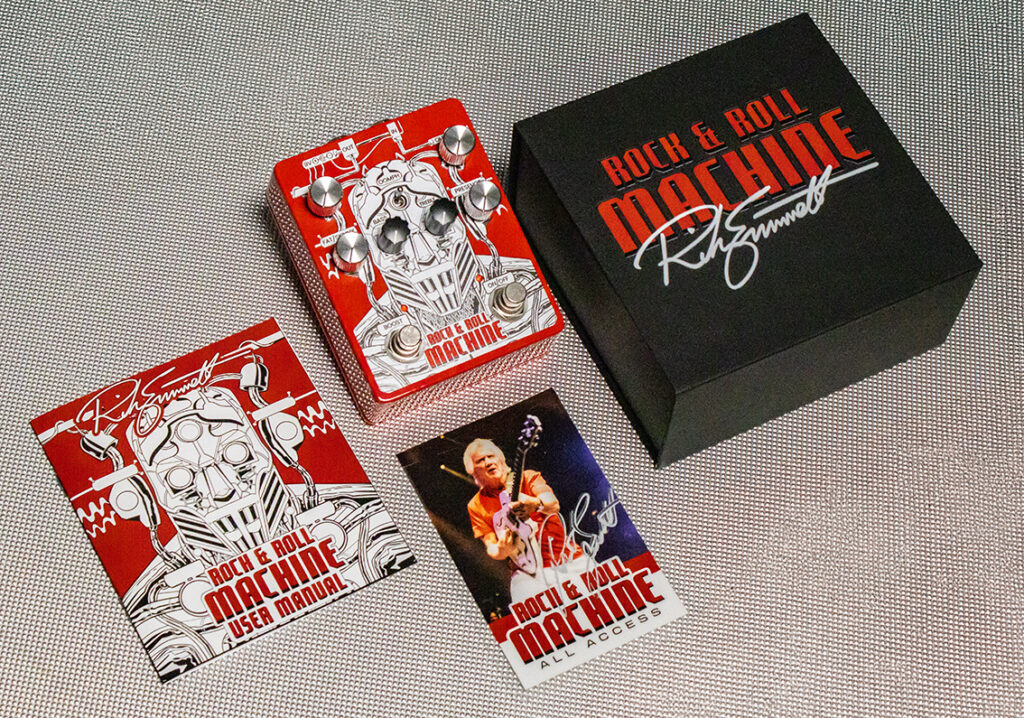
THE STORY BEHIND THE ROCK & ROLL MACHINE PEDAL, designed in collaboration with acclaimed solo artist and Triumph member Rik Emmett
A disciple of the Yardbirds alumni, those ‘Clapton, Beck, Page’ 1966 to 1975 rock tones schooled me. So, back in the 70’s & 80’s, the ‘Rik Emmett Rock & Roll Machine’ sound was humbuckers into a cranked 50 watt plexi. Modded with an attenuator on the power supply, the amp ran hot when the single master volume got to 4 or 5. At 7, the tone became more than enough of a saturated, compressed ‘brown’, for me.
I remain a fairly simple, back-to-basics kind of player. In the TRIUMPH trio, I had a lot of freedom for my versatility, but as a front-man singer, there isn’t a lot of time (or inclination) to dance around on pedals: turning the guitar volume down usually cleans up my tones.
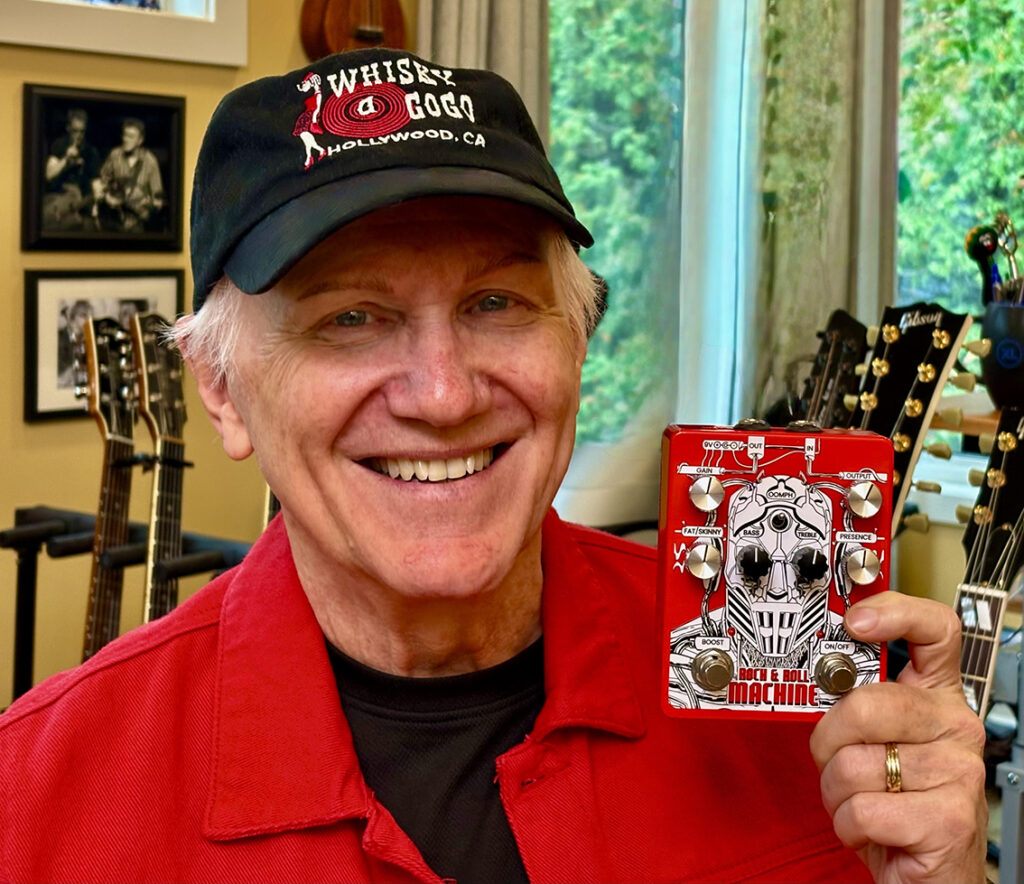
I’ve always run my amps with a bright, present, cutting tone. To me, a closed-back speaker cabinet gives all the bottom ‘punch’ required. (That’s the OOMPH switch!) Another old recording-signal-chain thing that was a big part of the TRIUMPH Rock & Roll Machine sound was NEVE EQ strips, providing their signature warm, fat mid-range presence.
So I asked the pedal designers to start there – then give it some more (optional) modern juice: the pedal should offer some of the ‘next generation’ evolution.
Guitar pickups provide clarity by reducing power – so my guitars start with a versatile sensitivity. This means the pedal needs articulate, responsive preamp gain stages: that’s critical.
When TRIUMPH went out on the ROCK & ROLL MACHINE RELOADED tour, I needed both boost and overdrive that could turn my guitar into a flame-thrower. What you’re holding in your hands is a powerful weapon: the ‘Maschinemensch’ from Metropolis evolved up to ‘Bane’ (with quite the grill!) – but don’t be fooled – this thing has got a dangerous fire in its guts, like ‘Smaug’. ~Rik Emmett
Rock & Roll Machine
Overview
A pedal named Rock & Roll Machine has to deliver everything a guitarist expects from a true rock & roll tone. Designed in collaboration with Rik Emmett, the Rock & Roll Machine is far more than a traditional distortion pedal. It combines rich, dynamic overdrive and distortion, an intuitive three-band EQ, and a transparent clean boost into a single compact unit.
Whether you’re looking for vintage crunch, singing lead tones, or simply pushing your amplifier harder with a clean boost, the Rock & Roll Machine provides the flexibility to cover virtually any rock guitar sound. Each control has been carefully voiced to make dialing in great tone fast, intuitive, and musical.
Power Requirements
The Rock & Roll Machine operates on a 9V DC negative-center power supply and draws approximately 70 mA of current.
Warning: Use only a regulated 9V DC negative-center power supply. Applying more than 9 volts DC may permanently damage the unit and will void the warranty.
Input & Output
The Rock & Roll Machine features top-mounted input and output jacks, maximizing available space on your pedalboard while keeping cable routing clean and organized.
● INPUT (Right): Connect your guitar or the output of the previous pedal in your signal chain.
● OUTPUT (Left): Connect to the input of your amplifier or the next pedal in your effects chain.
Gain
The Gain control adjusts the amount of drive produced by the pedal, ranging from light edge-of-breakup tones to thick, saturated rock distortion.
Because the pedal responds exceptionally well to your guitar’s volume control and picking dynamics, you can easily transition from clean, expressive passages to aggressive overdrive without changing pedal settings.
Output
The Output control adjusts the overall output level of the pedal. It can be used to match your bypass volume or provide up to 3 dB of clean volume boost, making it ideal for pushing your amplifier or adding presence in a live mix.
Fat / Skinny
The Fat/Skinny control shapes the overall body and character of your tone. Rotate toward Fat to add warmth, thickness, and low-mid fullness for a bigger, heavier sound. Turn toward Skinny to tighten the response and enhance clarity, making it ideal for brighter guitars or cutting through a dense mix.
Bass
The Bass control adjusts the low-frequency content of your signal. Increase the Bass for a fuller, more powerful sound, or reduce it to tighten the low end and improve note definition—especially when playing through high-gain amplifiers or humbucker-equipped guitars.
Treble
The Treble control adjusts the high-frequency content of your signal. Increase it to add brightness, sparkle, and articulation, or reduce it to tame harshness and create a warmer, smoother tone.
Presence
The Presence control fine-tunes the upper harmonics and high-end attack of your sound. Unlike the Treble control, which adjusts the overall high frequencies, Presence emphasizes clarity and bite, helping your guitar stand out in the mix without becoming overly bright.
Oomph Switch
The Oomph switch changes the character of the pedal’s low-frequency response.
● Oomph adds additional low-end fullness, allowing chords and single notes to bloom with greater depth and richness.
Experiment with both positions to find the response that best complements your guitar, amplifier, and playing style.
Boost
The Boost footswitch engages the pedal’s gain circuit, activating the amount of drive set by the Gain control. Use it to transition from clean or lightly driven tones into rich overdrive or saturated distortion.
Note: The Boost footswitch only functions when the pedal is turned On. If the pedal is bypassed, the Boost circuit is inactive.
On/Off
The On/Off footswitch engages or bypasses the Rock & Roll Machine. When engaged, the pedal’s EQ section is active, allowing you to shape your tone even if the Boost is turned off.
EQ-Only Operation
The Rock & Roll Machine can also function as a dedicated EQ pedal. Simply engage the On/Off footswitch while leaving the Boost disengaged. In this mode, the Gain circuit remains inactive, allowing you to use the pedal solely for its powerful EQ shaping and output level control.