


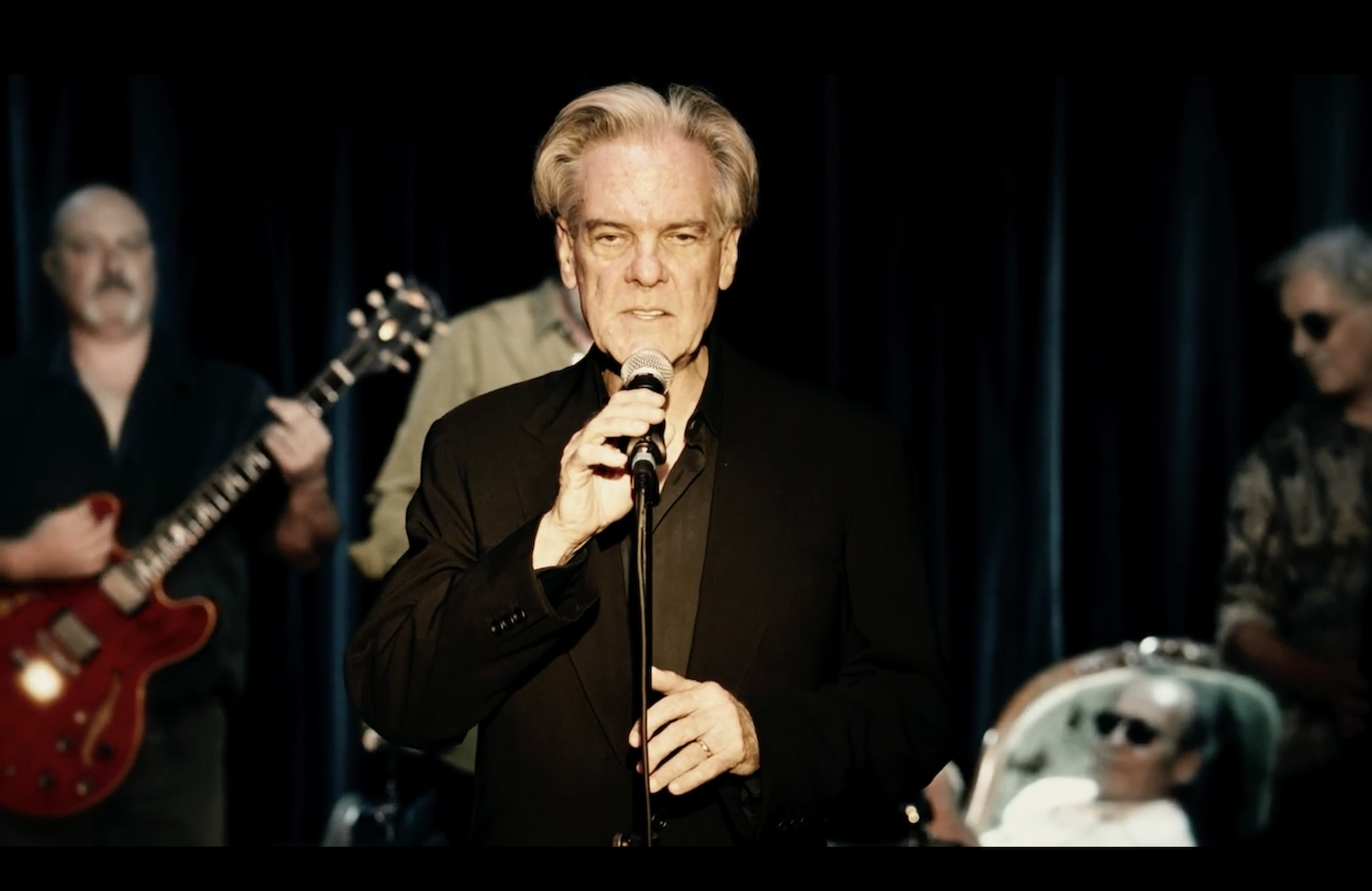
Acclaimed Australian songwriter, Don Walker, returns with his fifth solo record, Love Songs, a deeply personal and beautifully crafted new album, which is available now. The release precedes the much-anticipated Love Songs Album Tour, which begins on October 16.
From the guy who has etched his name in Australian music folklore by penning classic tunes such as Khe Sanh, Flame Trees, Standing On The Outside, Four Walls, Choirgirl and Saturday Night to name a few, Love Songs explores the many different kinds of love, told as only Walker can uniquely narrate. In Chisel, as Australian Musician editor Greg Phillips humorously points out in our recent interview, Don was never the George Harrison of the legendary Australian band, the other members were always keen to discover what Walker was bringing to the table next. With his solo material, Walker is totally in control and at home with his new band of brothers The Suave Fucks and sisters, The Harmonettes, bringing life to these intricate tales of intrigue.
For Don Walker, the release of an album isn’t really about sales targets, chart positions or even what happens once the record reaches an audience. The real objective comes much earlier, in the painstaking process of turning an idea in his head into a finished song.
“I think it’s in the process of making it,” Walker says when asked about his hopes and goals for his fifth solo album, Love Songs. “My hopes and goals involve the process of making each song and making it as close as I can to what I hear in my head.”
It’s an answer that neatly captures Walker’s approach to music. Across his work with Cold Chisel, Catfish, Tex Don & Charlie and his solo recordings, he has established himself as one of Australia’s most distinctive songwriters, with a fascination for character, place, rhythm and the details of everyday life.
 Love Songs, released through MGM Distribution on 180g vinyl, CD and digital, is perhaps his most intimate collection yet. Its nine songs move between sparse, piano-led storytelling and richer arrangements of guitars, steel, horns and harmonies. The result is an album that feels both timeless and immediate.
Yet the record didn’t begin life as a collection of love songs.
The idea emerged from a rather more practical exercise. Walker had two songs left over from his previous album, Lightning in a Clear Blue Sky, released three years earlier, as well as “Darwin”, a long-form song that had particular significance for the band because of its connection to the late Glenn Hannah.
“I had two songs that didn’t fit with the last album but were very good, I thought, and releasable,” Walker explains. “And I had a third long song, Darwin, which I had recorded with the other guys because it was a song that was very dear to us because of the involvement with Glenn Hannah in the gestation of it.”
Looking at those three recordings, Walker realised he effectively had half an album. The next question was what else might fit. “And I guess it’s around that time that the idea of Love Songs as a title and an aim came along.”
The title might sound simple, but Walker’s interpretation of the love song is anything but formulaic. He says he would never deliberately sit down with the intention of writing one. “I wouldn’t set out to write a love song,” he says. “I don’t think I’ve ever felt like that. They come out of their own volition.”
His benchmarks include Bob Dylan’s “Most of the Time” and the work of Leonard Cohen, particularly “Dance Me to the End of Love”. But Walker’s own songs tend to emerge less from direct observation than from accumulated experience.
“I don’t think not in the sense that you observe something and go and write a song. I never do that,” he says. “Songs often come out as a result of a long gestation, like a period of life in a certain place.”
In that sense, songwriting is less about capturing a moment than allowing experience to ferment. “You could say that they come from not from observation but from experience in that way. And some, as you mentioned, just come from imagination, just make it up.”
One of the more remarkable aspects of Love Songs is that some of its material has been waiting patiently for its moment. “Let’s All Get Together” and “The Girl I Used to Know” had both been sitting in Walker’s catalogue for more than two decades. The latter dates back to the 1990s, while “Let’s All Get Together” had been recorded by several other artists over the years, though never by Walker in the way he originally imagined.
“They’re songs that I really loved for more than 20 years,” he says.
Eventually, he decided it was time to give them his own treatment. “I just thought people haven’t heard these and I think they’re songs that people would like.”
“The Girl I Used to Know” had even been pitched to Cold Chisel more than once. But Walker is quick to dismiss the idea that its rejection represented some kind of injustice.
“There’s nothing special about a song that’s been rejected,” he says. “There’s not necessarily a real fault in the song or a reason why songs don’t get on.”
Cold Chisel’s albums are, after all, collaborative affairs. The band generally aims for a disciplined 10-song album, despite having considerably more material available.
“Members of the band bring in more songs than we need and I do too,” Walker explains. “And then there are people that are close to the band that pitch in songs too.”
The songs that survive are simply the ones the other members connect with. “A song that sticks is a song that the other guys like and feel compelled to do.”
That collaborative history is particularly important to “Darwin”, the album’s epic 14-minute centrepiece. What makes a story worth telling for 14 minutes rather than three and a half?
“People don’t walk out,” Walker jokes. “Is the only justification.”
The song had already been tested live, including on a 2018 tour. Walker admits there was some apprehension that an audience might lose patience after seven minutes.
“They just put their seatbelts on and sat through it and really enjoyed it.”
It’s a characteristically understated assessment of a song that demands considerably more patience than the average radio single.
Musically, “Darwin” also points to one of Walker’s less obvious influences. Along with the album opener “Let’s All Get Together”, it carries a Latin American flavour, something Walker traces largely to Argentine composer Astor Piazzolla.
Piazzolla took the instrumentation and rhythms of tango and expanded them into something approaching miniature symphonies.
“That’s mainly my exposure to Latin American music and rhythms,” Walker says.
Walker’s ability to move between styles depends heavily on the musicians around him. Australian Musician describes his band as something like the kind of exceptionally versatile ensemble one might encounter in a Nashville studio, quality players who can turn their hands to almost anything, and, importantly, “nice guys”.
But the current lineup exists in the shadow of considerable loss. For around a decade, Walker had worked with guitarists Roy Payne and Glenn Hannah. Hannah died in 2019, while Payne died in 2022.
“We had a very settled lineup with Roy Payne and Glenn Hannah playing guitars, and we lost both those men,” Walker says.
The challenge was then how to reconstruct the band without them. The answer was Shannon Bourne on guitar, with the current configuration operating with a single guitarist, a testament to Bourne’s instrumental skills.
It’s another example of how Love Songs exists within a much longer musical history. Old songs have been revived, old collaborations have been remembered and a new version of the band has been assembled to carry the material forward.
Walker’s piano playing is another important component of his musical identity, although he is the first to downplay his technical credentials. His principal piano influence is Thelonious Monk, whom he describes as an “aspirational influence”.
“I can’t play like him,” Walker admits. “I’m not dextrous enough or knowledgeable enough to be a jazz player.”
Still, jazz pianists are generally the players he most enjoys listening to, with Monk among his top three.
On Love Songs, most of the tracking was recorded at Headgap Studios in Preston, Melbourne, using the studio’s grand piano. And while Walker may be modest about his piano skills, he applies the same standards to his playing as he does to his songwriting.
“I’ll do a number of piano takes. It’s like writing. You know when the right one is done and you get a nagging feeling when you know it’s not as good as it could be.”
That “nagging feeling” is perhaps one of the defining characteristics of Walker’s creative process. He knows when something isn’t finished because the thought won’t leave him alone.
“When a song’s done is … I get a nagging feeling that won’t go away when a song’s not done,” he says. “But I know when it’s done.”
There have been rare occasions when he has ignored that feeling, only to realise months later that a line or detail should have been changed. “That’s not good,” he says. “But that’s very rare.”
The same exacting attitude extends to performance. Walker has little patience for bands that hang around at either end of a song, teasing the audience with extended introductions or endlessly hammering the final chord.
“Once you’ve got to the end of the song, do a clean ending and get on with life with the next song,” he says.
He feels much the same about openings. “I like to avoid that very much. I think get in there. People want the song.”
There is, however, a curious irony in Walker’s approach. He recognises that some of Cold Chisel’s most famous songs have iconic introductions, including “Khe Sanh”, “Choirgirl” and “Four Walls”, as well as the organ opening of “Breakfast at Sweethearts”.
But he says those intros weren’t necessarily carefully conceived. “They were just reeled off while I was thinking about more important things.”
Their significance, he suggests, has come through repetition. “They become special through repetition.”
On Love Songs, he has deliberately used a more recognisable opening for “The Girl I Used to Know”, which he describes as probably the album’s most commercial song.
“There’s a signature thing that you hear and you go, ‘Oh, I know this one.'”
Although Walker is meticulous in the studio, he accepts that songs will inevitably change once they hit the stage. Songs evolve on the road, sometimes without the musicians even noticing.
“Even to the extent of lyrics develop on the road without you being conscious of it,” he says. “Not a great deal, but little details here and there.”
He likes that process. “It’s the process of songs becoming lived in.”
That idea seems particularly appropriate for an album containing songs that themselves have taken years, even decades, to find their final form.
Walker’s songs may begin in imagination, experience or an old notebook, but they continue to evolve through recording, performance and repetition.
For someone who insists that songwriting itself is the most important part of making a record, Walker nevertheless puts enormous thought into what happens when the songs are assembled into an album. Track sequencing remains “very much” important to him.
After mixing Love Songs in Nashville last November, he had to begin thinking about the order in which the songs would sit together. That process involved more than simply deciding which song sounded good after another.
“You’re balancing not only keys, but the experience of the last song,” he explains.
There is also the physical reality of vinyl. With vinyl once again playing an important role in the album market, Walker considered the length of each side and tried to keep the two sides as short and balanced as possible.
“There’s a lot of time and effort that goes into that.”
The attention to sequencing mirrors his broader philosophy. Walker doesn’t follow a songwriting formula, and he doesn’t seem interested in repeating himself.
“Every new song is a new process of problems and solutions and discoveries that’s quite different than anything that’s gone on before.”
He acknowledges that formulas and templates exist, and that Nashville has taught him plenty about them. But knowing how a song can be constructed doesn’t mean he has to use the blueprint.
“I spent a lot of time over the decades in Nashville where that kind of thing is an art form.”
The next stage of the Love Songs project is the live tour, beginning at Melbourne’s Memo Music Hall on 16 October. Walker won’t perform the entire album. One song in particular, “It Will Always Be You”, presents a technical challenge that he doesn’t think is worth taking to the stage.
“I’ve never done live and it would be right on the edge of what I can do and always nail it,” he says.
He estimates that performing it consistently would result in a “car crash” around two out of every five times.
“So why put people, including myself, through that?”
For the solo shows, Walker will rely on a single Nord keyboard, without a backup. He’s confident in its reliability, noting that the only serious stage failure he can recall involved a mechanical problem with a Yamaha CP70 back in 2010.
The Love Songs tour will take Walker and his songs from Melbourne to Geelong, Sydney, Eumundi and Brisbane, with songwriter Jimmy Dowling supporting.
But Walker is already looking beyond the tour.
For now, Love Songs is effectively finished as a creative project. “The project finishes for me when the album is finished,” he says.
The remaining work, film clips, artwork and the other associated tasks is ancillary. His attention has already moved elsewhere, particularly to a prose project he has been working on for several years.
There may also be a small jazz-oriented performance somewhere down the track. A couple of friends in Sydney’s jazz community have suggested a trio show in a small venue.
Walker is intrigued by the idea. “I’d like to do small-form performance where I don’t have many people to hide behind. Like to give that a try.”
It is perhaps the perfect Walker proposition: strip things back, remove the safety net and see what happens.
For a songwriter who has spent decades refining his craft, there is still no sense that the answers have been found. Each song remains another problem to solve, another discovery to make.
And perhaps that is the real story behind Love Songs. These aren’t simply songs about romance. They are songs about time…songs that have waited decades, songs that have been reshaped by experience, songs that have lived on stage and songs that eventually found their place together.
Walker may not be chasing a Top 10 album or a particular sales figure. He’s chasing the sound he hears in his head. And after more than 50 years of songwriting, he still seems to have plenty of songs worth chasing.
LOVE SONGS 2026 TOUR ON SALE NOW AT donwalker.com.au/live
With Special Guest Jimmy Dowling
Friday, 16 October 2026
Memo Music Hall, Melbourne VIC
Saturday, 17 October 2026
Eureka Hotel, Geelong VIC
Saturday, 24 October 2026
Factory Theatre, Sydney NSW
Friday, 30 October 2026
Imperial Hotel, Eumundi QLD
Saturday, 31 October 2026
Old Museum, Brisbane QLD