


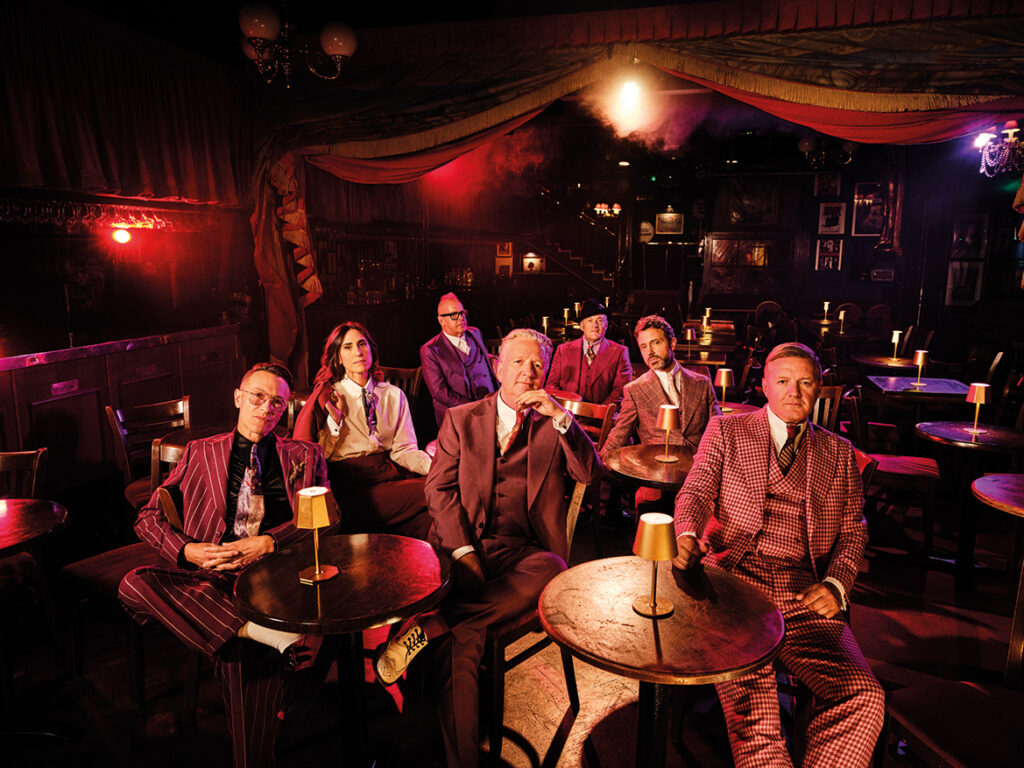
For Glenn Tilbrook, Squeeze’s forthcoming Australian tour represents more than another trip down under. When the band returns in April 2027 for its Tried, Tested and Trixies tour, it will be Tilbrook’s fifth visit to Australia with Squeeze, and he still vividly remembers the excitement of the band’s early success here. Their first Australian tour in 1980 introduced them to a thriving local music scene, where they crossed paths with bands including Split Enz. After last visiting in 2018 and having a planned 2021 tour cancelled by the pandemic, Tilbrook is particularly pleased to finally be returning, he tells Australian Musician
editor Greg Phillips
MORE ABOUT THE INTERVIEW
The tour will showcase Squeeze’s celebrated catalogue alongside material from Trixies, the band’s extraordinary new album released in March 2026. The record is unique in Squeeze’s history: while it is their first album in eight years, it is also the first collection of songs they ever wrote. Tilbrook and Chris Difford composed the material as teenagers. Tilbrook was just 16 and Difford 19 before putting the songs away on cassette for more than five decades.
Tilbrook describes revisiting those songs as something of a gift from their younger selves. The pair had always known and loved the material, but there was never an obvious place for it in Squeeze’s early career. By the time they were signed in 1977, the musical climate was dominated by punk and new wave, making the ambitious concept album they had written as teenagers an unlikely proposition. More importantly, the young Squeeze simply lacked the musical experience to realise the songs properly.
Fifty years later, that problem has disappeared. Tilbrook says the songwriting integrity of the original material was astonishing, requiring remarkably little alteration beyond a few words here and there. What did change was the band’s ability to arrange and perform it. Songs such as “The Place We Call Mars” revealed a sophistication he doubts he could reproduce if he were writing them today, while the new recordings allowed the mature Squeeze to bring decades of playing and arranging experience to the teenage compositions. The album was produced by Squeeze bassist Owen Biddle, whose credits include The Roots, John Legend and Al Green.
Trixies revolves around a fictional nightclub, but Tilbrook deliberately prefers the concept to remain ambiguous. Rather than presenting a detailed narrative, the songs offer fragments of characters and scenes, leaving gaps for the listener’s imagination. That openness, he believes, is one of the album’s greatest strengths. Musically, the record also reflects the adventurousness that has always been part of Squeeze, with unusual and characterful instruments contributing to its atmosphere while remaining unmistakably Squeeze.
The experience of completing Trixies has also reinforced Tilbrook’s belief that the band is now better than it has ever been. Squeeze currently performs as a large ensemble, capable of moving from sophisticated arrangements to sparse, stripped-back passages and then rocking with considerable force. He says the audience reaction has reminded him of the raw excitement surrounding the band in 1978 and 1979.
That confidence extends to the stage, where Tilbrook has continued to develop his distinctive guitar style. Although his playing is rooted in blues, he has long incorporated jazz influences, particularly in his carefully constructed solos. Rather than treating a solo as an opportunity for improvisational flash, Tilbrook often works it out in the studio and then learns the completed part as an integral component of the song. His principal touring guitar remains the Fender Telecaster, supplemented by a Gibson ES-345, while he admits to being emotionally attached to his considerable guitar collection.
There is also a strong family connection within the current Squeeze lineup, with Tilbrook’s son Leon now playing guitar in the touring band. Tilbrook describes sharing the stage with his son as an “unescapable joy”, noting that Leon brings confidence, assertiveness and a natural stage presence to the group. His musical ambitions were evident from an early age, with Tilbrook recalling family tours during which Leon would gradually make his way onto the stage and play along with the band.
Despite Squeeze’s long history, Tilbrook remains open to contemporary music. He cites artists such as Dave, Stormzy and Kae Tempest as sources of inspiration, explaining that while he would never attempt to imitate their music within Squeeze, he can absorb the heart and soul of what they are doing and translate that energy into the band’s own language. For him, that willingness to remain receptive to new music is an important part of keeping Squeeze fresh.
Technology too, has never been something Tilbrook has resisted. He embraced digital recording early, working with ADAT machines before eventually moving to Pro Tools, which he still prefers to use essentially as a straightforward recording machine. He is considerably less enthusiastic about artificial intelligence in music, however, saying he has no desire to become involved with it. For Tilbrook, the human endeavour involved in making music remains central to the process.
One of the most poignant moments in the interview comes when Tilbrook discusses “Some Fantastic Place”, a song he wrote about his first proper girlfriend, Maxine, whose family welcomed both Tilbrook and Difford into their home, the same environment in which the pair wrote Trixies. Maxine died in her 30s, and Tilbrook recalls the song as one of those rare pieces that seemed to write itself. It remains particularly close to his heart.
Interestingly, Trixies has not simply sent Squeeze looking backwards. The band actually recorded two albums concurrently: the rediscovered teenage material and 13 entirely new Squeeze songs. Tilbrook says it was important not to become trapped in nostalgia, with the two projects informing each other creatively. The new album is already completed and will be revisited at the beginning of 2027.
That forward momentum seems central to Tilbrook’s current outlook. Reflecting on his career, he says one of his greatest revelations came after Squeeze split for the second time, when he found himself happily playing small clubs. The experience taught him to stop measuring his happiness by levels of success and instead appreciate wherever music took him. That attitude has allowed him to retain his enthusiasm without becoming consumed by disappointment or expectations.
Now, with Squeeze celebrating more than five decades of songwriting and returning to Australia, Tilbrook appears to be enjoying a particularly rich chapter. Trixies has allowed him and Difford to reconnect with the teenagers who first dreamed up Squeeze, while the new material waiting in the wings suggests that the story is far from finished. As Tilbrook puts it, revisiting those early songs has made him aware not only of what the young Squeeze had already achieved, but also of all the music he has yet to discover and write.
Squeeze’s Tried, Tested and Trixies Australian tour will visit Brisbane’s Fortitude Music Hall on April 16, Sydney’s Enmore Theatre on April 17, Melbourne’s Palais Theatre on April 19, Adelaide’s Gov on April 20 and Perth’s Astor Theatre on April 22, 2027. Alongside Tilbrook, the touring lineup will include Owen Biddle, Steve Smith, Stephen Large, Simon Hanson, Leon Tilbrook and Danica Dora.
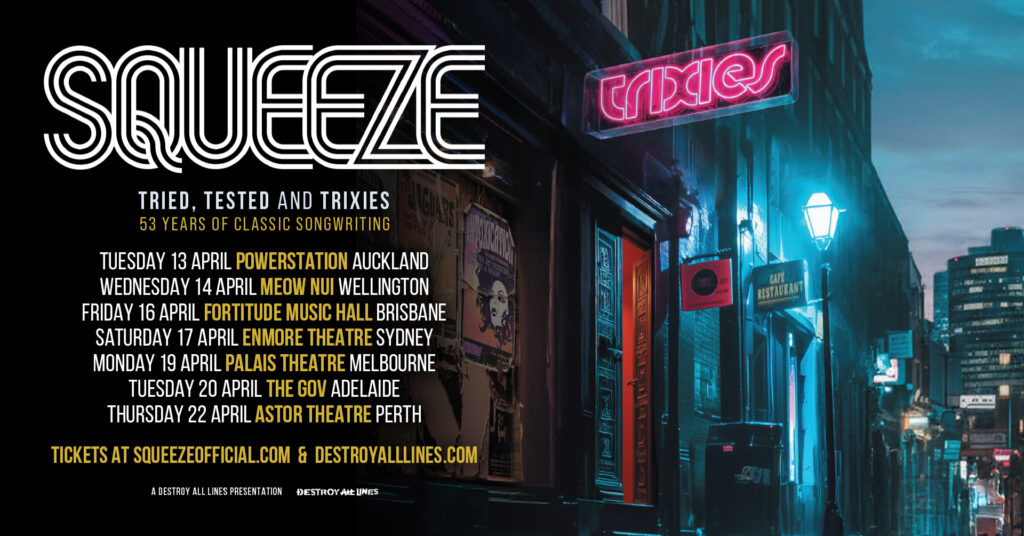
SQUEEZE
TRIED, TESTED AND TRIXIES
53 years of classic songwriting
Friday 16 April Brisbane Fortitude Music Hall
Saturday 17 April Sydney Enmore Theatre
Monday 19 April Melbourne The Palais
Tuesday 20 April Adelaide The Gov
Thursday 22 April Perth Astor Theatre
Tickets and further information via www.squeezeofficial.com and destroyalllines.com