

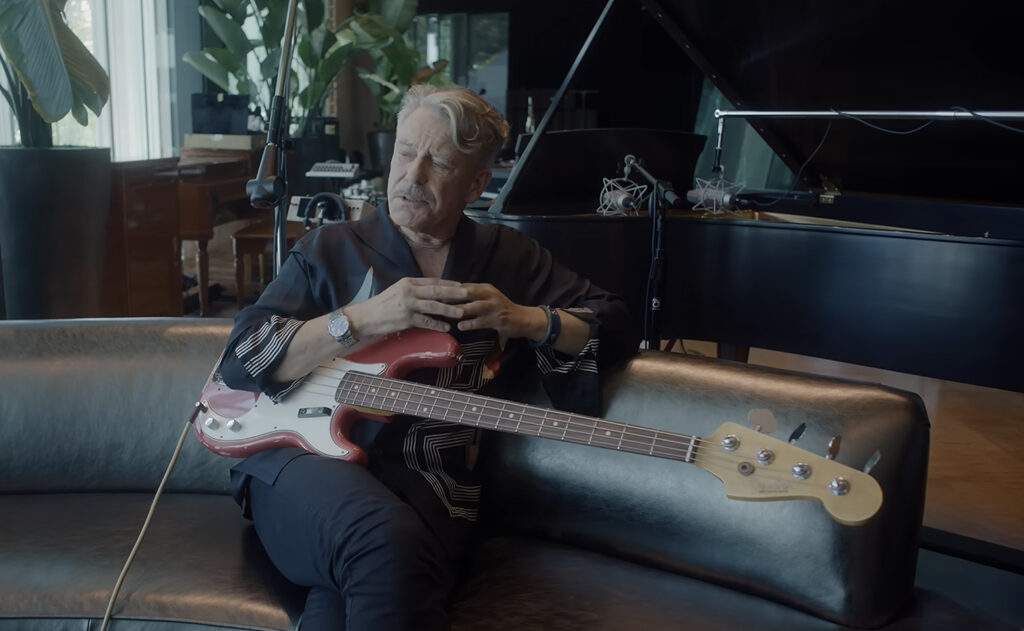
Fender & U2’s Adam Clayton: Continuing with the 75th Anniversary milestone of the P Bass, Fender and U2’s Adam Clayton catch up to discuss the enduring influence of the P Bass on his playing and career. Watch the episode here: Adam Clayton Talks the Precision Bass | Fender
Adam Clayton describes the Fender Precision Bass as the instrument that shaped both his musical identity and the sound of U2, praising its simplicity, versatility and enduring design. Growing up in the UK during the 1970s, Clayton recalls how watching bassists in punk bands on shows like Top of the Pops and The Old Grey Whistle Test inspired him to take up the instrument, noting that nearly all of the players he admired were using Precision Basses.
Clayton’s first “proper” bass was a second-hand sunburst Precision Bass purchased by his father during a trip to New York. Although he admits he wasn’t especially close to his father, the purchase became an important bonding moment and marked the beginning of his lifelong relationship with the instrument.
Among his biggest influences were Jean-Jacques Burnel of The Stranglers for his aggressive, powerful style, Paul Simonon of The Clash for his melodic approach and fusion of reggae influences, and Motown legend James Jamerson, whom Clayton regards as inseparable from the Precision Bass’s legacy.
He believes the Precision Bass became the instrument of choice for the punk generation because of its straightforward design. Unlike some competing basses, it allowed inexperienced players to achieve a great sound immediately, making it ideal for musicians driven more by attitude than technical ability.
Clayton also credits Leo Fender’s design for revolutionising bass playing, describing the Precision as more portable and playable than an upright bass while retaining a tonal character somewhere between an upright and a cello. That unique voice, he says, gives bass players enormous influence over the harmonic foundation of a song.
Discussing U2’s songwriting process, Clayton explains that the band’s stripped-back line-up of guitar, bass, drums and vocals gave him plenty of room to shape the music. With The Edge often playing arpeggiated parts rather than full chord changes, the bass frequently drives the harmonic movement, creating the distinctive interplay between bass and drums that underpins many of the band’s songs.
Although largely self-taught, Clayton sees his lack of formal training as an advantage, allowing him to approach the instrument instinctively rather than being constrained by musical rules. His focus has always been on serving the song and locking in with the drummer.
He also talks about his favourite “Frankenstein” Precision Bass, modified with a Jazz Bass neck and Badass bridge, which became his primary recording instrument through to Achtung Baby. It featured on classics including “New Year’s Day” and “Bullet the Blue Sky”, and he admits it instantly transports him back to that era whenever he plays it.
When choosing a Precision Bass today, Clayton says weight is the first thing he considers, as it affects tone, balance and comfort during long performances. He also praises a custom leather-clad Precision Fender built for U2’s Sphere residency and explains his fondness for custom sparkle finishes, with Fender’s Custom Shop creating a unique sparkle bass for each tour.
Clayton describes the Precision Bass as his “go-to” instrument and trusted workhorse. Whether writing, recording or performing, he values its familiar feel, wide tonal range and dependable simplicity, saying it allows him to focus entirely on making music rather than thinking about the instrument itself. Reflecting on his original Precision Bass, he reveals he was forced to sell it early in U2’s career to fund the band’s return to Dublin after running out of money, a decision he still regrets but sees as part of the learning experience.
Visit FENDER WEBSITE: https://www.fender.com